RenovationRoute
· Federal Contracting · 6 min read
The $50K Strategy, How Small Contractors Get Federal Work Without Bonding or Past Performance
Stop chasing $5M contracts you can't win. Learn how small contractors break into federal construction with micro purchases and simplified acquisitions under $250K.
Introduction
Most contractors give up on federal contracting after one look at SAM.gov.
They see 4,000+ active opportunities, $5M VA hospital renovations, $12M infrastructure upgrades and think “I can’t compete.”
They’re right about those projects. But they’re missing the 8-12% of opportunities under $250K that don’t require bonding or extensive past performance.
The problem isn’t that these opportunities don’t exist. It’s that SAM.gov makes them impossible to find.
The Micro-Purchase Entry Point Hidden in Plain Sight
Federal agencies must post construction work on SAM.gov even for small projects:
- $10,000 - $25,000 (micro-purchases) - no past performance required
- $25,001 - $250,000 (simplified acquisitions) - minimal bonding, lighter documentation
In 2025, the Army Corps of Engineers alone posted 847 construction micro-purchases. VA facilities posted 612.
Most got 0-3 bidders.
Not because contractors aren’t interested because they never found them in time.
Why SAM.gov (Free) Falls Short for Small Contractors
SAM.gov is free. It’s the official government platform. So why do 80% of contractors give up? Reminds me of going to the DMV, just thinking about it puts stress on me.
Problem 1: Manual Filtering Through Thousands of Irrelevant Contracts
You set filters for “construction” + “your state” and still get 400+ results. Most are:
- Outside your bonding capacity
- 300 miles from your location
- Set-asides you don’t qualify for
- Already past the deadline
Hours wasted scrolling.
Problem 2: Critical Compliance Requirements Buried in 50-Page PDFs
You find a $75K roof repair project. Perfect size.
You download the solicitation. Page 42: “DFARS 252.204-7012 applies” (which means CMMC Level 2). Or buried in Amendment 0003: “Personnel require facility credentials per HSPD-12” (SECRET clearance).
Automatic disqualification. 40 hours of prep work wasted.
Problem 3: Opportunities Disappear Before You See Them
SAM.gov’s email alerts are delayed 12-24 hours. By the time you see the notification, competitors already submitted bids.
Most micro purchases have 7-14 day response windows. Losing 1-2 days = 10-15% less prep time.
Problem 4: No Way to Know Your Win Probability
You bid on a $125K project. Seems perfect.
Turns out:
- It’s 200 miles away (travel costs kill your margin)
- Previous bids failed twice (complexity red flag)
- You’re competing against 8 contractors vs the usual 2-3
You had no way to know before investing time.
How RenovationRoute Automates This Entire Process
We built what SAM.gov should have been for small contractors. $20/month gives you:
Automatic Discovery + Instant SMS Alerts
- Monitor SAM.gov every 6 hours for construction projects in your radius (5-500 miles)
- SMS alerts within minutes of posting (12-24 hours faster than SAM.gov emails)
- Pre-filtered by contract size, NAICS, location automatically
Stop checking SAM.gov manually 3 times per day.
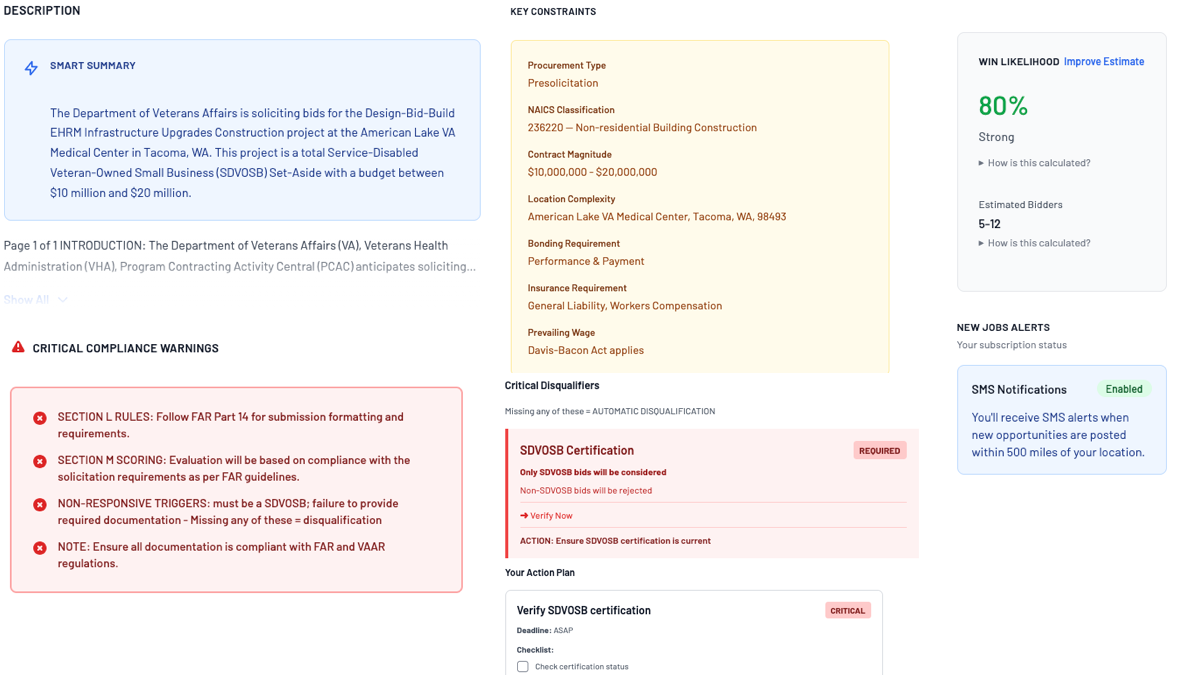
Compliance Red Flags Before You Waste Time
We did the hard work for you. Looking through the fine text to make sure you know of all the gotchas before wasting time.
Automated analysis detects:
- CMMC requirements (Levels 1, 2, 3)
- Security clearance needed
- Previous failed bids (and why)
- 4+ amendments issued (complexity warning)
- Bonding requirements vs your stated capacity
You see the dealbreakers before downloading the 50-page PDF.
Win Likelihood Calculator (13-Factor Scoring)
Instant probability based on:
- Eligibility (+25 pts if you match set-aside category)
- Specialized experience (+20 pts for heavy civil/technical work)
- Past performance (+15 pts for proven federal track record)
- Capability (+12 pts for bonding/insurance)
- Logistics (+5 pts if project is <50 miles away)
- Bid window (+10 pts for adequate prep time)
- Penalties for scale risk, compliance complexity, rush timelines
You see exactly why you score 52% vs 87% on each opportunity.
Estimated Bidders (Competition Level)
Predicts 2-9 competitors based on:
- Set-aside type (small business = fewer bidders)
- Contract size ($50M+ = fewer, $10K-$50K = more)
- Timeline (≤7 days = fewer, ≥30 days = more)
- NAICS specialty (electrical, HVAC = fewer)
- Geography (metro vs remote states)
Stop wasting time on saturated opportunities.
Plain English Summaries
Government solicitations are 50+ pages of dense legal language. We extract:
- Certifications needed
- Budget ranges
- Critical deadlines
- Scope breakdown
2 minute evaluation vs 2 hour document review.
→ See How RenovationRoute Works
What These Small Projects Look Like
Real examples from January 2026:
- $18,500 - Replace HVAC unit at VA clinic, Nebraska
- $42,000 - Roof repair on Army National Guard armory, Montana
- $87,000 - ADA-compliant bathroom renovation, federal courthouse, Iowa
- $125,000 - Parking lot resurfacing, military reserve center, Wyoming
These projects don’t require:
- Performance bonds (under $150K threshold)
- Extensive past performance (simplified evaluation)
- Security clearances
- 200-page proposals
The Catch-22 Solution: Build Past Performance Fast
Win 3-5 micro-purchases ($10K-$50K each) in 12-18 months.
Now you have:
- Federal past performance (required for $250K+ contracts)
- Proof you can handle government paperwork (WAWF invoicing, certified payroll)
- References from contracting officers (gold for future bids)
- Higher bonding capacity (surety companies see federal work favorably)
Common Mistakes That Kill First Time Bidders
1. Bidding too far from your location
Travel costs eat profit on small jobs. Stick to 50-100 mile radius unless it’s specialty work.
2. Ignoring the RFP questions
“Provide 3 references for similar work” if you skip this, you’re disqualified. Answer every single requirement, even if it seems redundant.
3. Not reading amendments
40% of solicitations get amended (changed deadlines, scope tweaks). If you miss an amendment, your bid might be invalid.
4. Overcomplicating the proposal
For $25K jobs, a 5-page proposal is enough. Don’t hire a $2,000 consultant for a $15K bid.
5. Missing the wage determination
Davis-Bacon prevailing wage applies to most federal construction. If your bid doesn’t account for prevailing wages, you lose money.
RenovationRoute’s Plain English Summaries extract wage determinations automatically so you don’t miss this critical requirement.
The Reality: Federal Work Is a Volume Game at First
Your first year:
- Bid on 15-20 small projects
- Win 3-5 (20-30% win rate is normal)
- Gross $100K-$250K in federal revenue
- Build past performance portfolio
Your second year:
- Bid on $150K-$500K projects
- Win 30-40% (you have past performance now)
- Gross $400K-$800K
- Qualify for higher bonding limits
Year three and beyond:
- Access to $1M-$5M opportunities
- Established relationships with COs
- Subcontracting opportunities from primes
- Predictable federal revenue stream
Bottom Line
Stop chasing contracts you can’t win.
Start with $10K-$50K micro-purchases, build federal past performance, then scale up.
It’s not glamorous. But it’s how 90% of small contractors break into federal work.
Stop Manually Searching SAM.gov
Get instant SMS alerts for construction projects in your radius. Automated compliance warnings, 13-factor win likelihood scoring, and plain-English summaries save you 10+ hours per week. First 20 users locked in at $20/month forever.
Frequently Asked Questions
Can’t I just use SAM.gov for free?
Yes, but SAM.gov doesn’t filter by your bonding capacity, compliance requirements, or win probability or send notification. You’ll spend 10+ hours per week scrolling through irrelevant opportunities and miss critical compliance requirements buried on page 37 of PDFs.
RenovationRoute automates the filtering, sends SMS alerts within minutes (12-24 hours faster), and shows you red flags before you waste time.
Do I really need to check SAM.gov daily?
If you’re doing it manually, yes. The best opportunities get 0-3 bidders because most contractors find them too late.
RenovationRoute monitors SAM.gov every 6 hours and sends SMS alerts instantly so you never miss opportunities in your radius.
What if I’ve never done federal work before?
Start with micro-purchases under $25K. They don’t require past performance. Win 3-5 of these, then you have the references needed for larger contracts.
RenovationRoute’s Win Likelihood Calculator shows exactly which projects you should bid on as a first-timer (high eligibility score, low competition).
How long does it take to get SAM.gov registered?
7-14 days on average. You need a DUNS number, business licenses, and tax documentation. The process is free but requires patience.
Can I still bid if I don’t have bonding?
Yes, for projects under $150K. Most agencies don’t require performance bonds for simplified acquisitions. Once you have federal past performance, bonding becomes much easier to obtain.
What’s the biggest mistake new federal contractors make?
Bidding on projects too far from their location. Travel costs and lodging eat your profit on small jobs. Stick to opportunities within 50-100 miles unless it’s highly specialized work.