RenovationRoute
· Homeowner Guides · 8 min read
How to Pay a Contractor Safely: Deposits, Milestones, Escrow
The safest way to pay a contractor is to never get ahead of the work. Here is how much deposit is normal, how to structure a milestone payment schedule, and how holding each payment until you approve protects your money until the job is actually done.
Paying a contractor is where most home renovations go wrong. Not the demolition, not the permits, the money. You hand over a big deposit, the work starts slow, the contractor asks for more before the last stage is done, and suddenly you’re financing a project you can’t fully see. The fear is simple and it’s rational: once the money is gone, your leverage is gone.
The good news is that paying safely isn’t complicated. It comes down to one rule and a few habits that put you back in control. Here is how to do it.
The One Rule: Never Get Ahead of the Work
Every safe payment practice is a version of the same principle. Your money should always be slightly behind the progress on your home, never ahead of it. The moment you have paid for more than has actually been built, you have handed your leverage to someone else and you’re hoping they finish.
A contractor who is doing good work and being paid fairly along the way has no reason to object to this. A contractor who pushes hard for large payments up front, before you can see anything for it, is telling you something. Listen.
How Much Deposit Is Normal
A deposit is reasonable. It covers initial materials and reserves a spot on the contractor’s schedule. The question is how much.
For most residential projects, 10 to 25 percent is normal. Some states even cap how much a contractor can collect up front. A deposit in that range funds the start of the job. It doesn’t fund the whole job.
Be careful when you hear:
- “I need 50 percent to get started.”
- “Pay the full amount and I will give you a discount.”
- “I need the material money in cash today.”
None of these are automatically a scam, but all of them move money ahead of work, which is exactly the position you’re trying to avoid. A well run business has the working capital to buy the first round of materials against a normal deposit.
Use a Milestone Payment Schedule
The single most effective thing you can do is split the total price into milestones tied to real, visible progress, and put it in writing before anyone starts.
A kitchen remodel might look like this:
- Deposit (15%), to reserve the schedule and order long-lead materials
- Demolition and rough-in complete (25%), old kitchen out, plumbing and electrical roughed in and inspected
- Cabinets and drywall complete (25%), boxes hung, walls closed
- Countertops and finishes complete (25%), the kitchen is functional
- Final walkthrough and punch list (10%), everything on the list is done and you have signed off
The percentages shift by project, but the shape stays the same: you release money only when that stage is genuinely finished and you have seen it. The contractor stays cash flow positive enough to keep buying materials and paying crew, and you never pay for a stage that doesn’t exist yet. The work and the money move together.
Never Pay for Work You Can’t See
This is the habit that saves people. Before you release any milestone, walk the job. Look at it. If the milestone is “rough-in complete,” the rough-in should be complete and, where required, inspected. If it isn’t, the payment waits. No exceptions, no “I will finish it tomorrow, just release it today.”
Hold back a final payment, often 10 percent, until the punch list is done, the small final items that contractors are notorious for leaving unfinished once the big check clears. That last retention is your only leverage to get the last 5 percent of the work done well. Don’t give it up early.
How to Handle the Materials Money
Materials are where the deposit conversation gets real, and where a lot of well-meaning advice falls apart. Contractors aren’t being shady when they ask for money to buy materials, most of them genuinely can’t start without it. A small contractor doesn’t have the cash to float thousands of dollars of tile and lumber across several jobs at once. So “you get nothing until I see materials on the driveway” isn’t a fair ask for everyday materials, and a good contractor will walk away from it.
Here is how to handle it without being naive or unreasonable:
- Everyday materials: the deposit covers them, and that’s normal. A standard 10 to 25 percent deposit is the materials money. Your protection isn’t withholding it, it’s keeping it small. If the contractor disappears after the deposit, your loss is bounded to that deposit, not to half the job.
- Big special orders are the exception worth protecting. Custom cabinets, windows, a large long-lead tile order, these are big enough, and often non-refundable, that you can reasonably ask for them to be delivered to your property before that portion is paid, or paid to the supplier directly. A legitimate contractor won’t object to that on a large order, it’s common.
- On those big orders, a receipt isn’t proof. A receipt only proves someone bought something. It can be returned for a refund, reused from another job, or reversed. Tie the larger material payments to delivery, not paperwork.
The goal isn’t to make the contractor your bank. It’s to keep the deposit modest, and to protect only the big, expensive orders where the dollars actually justify it.
This is also where a held payment quietly solves the standoff. When the materials milestone is funded up front and held, the contractor can see it’s committed, so they will go place the order, and it releases to them once the work or delivery is confirmed. The money is there the whole time, just not released until it should be. Neither side has to front anything on trust.
What About Escrow?
Escrow means a licensed third party, an escrow company, holds your money and pays the contractor when the conditions in a written escrow agreement are met. It’s a solid option for a large project, especially new construction or a big addition. It costs a fee and adds paperwork, and both sides have to agree on exactly what releases each payment.
RenovationRoute is not an escrow company. If you want real escrow, use a licensed escrow company. For most remodels you don’t need one. A small deposit and a milestone schedule where you only release payment for finished work does the same job.
What Holding the Payment Actually Does (and Why It Is Safer)
A milestone schedule is good. Holding each payment until you approve makes it enforceable.
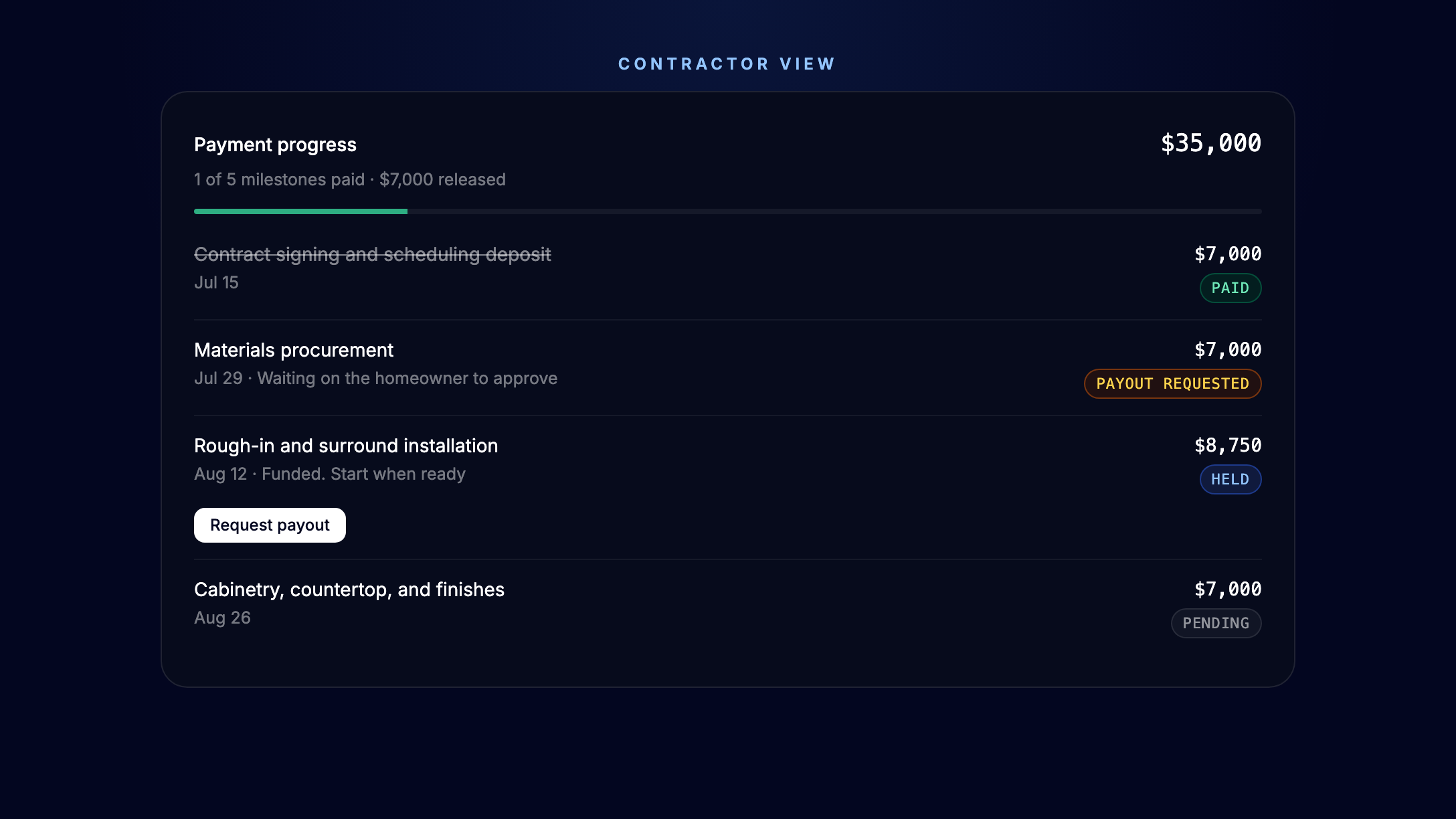
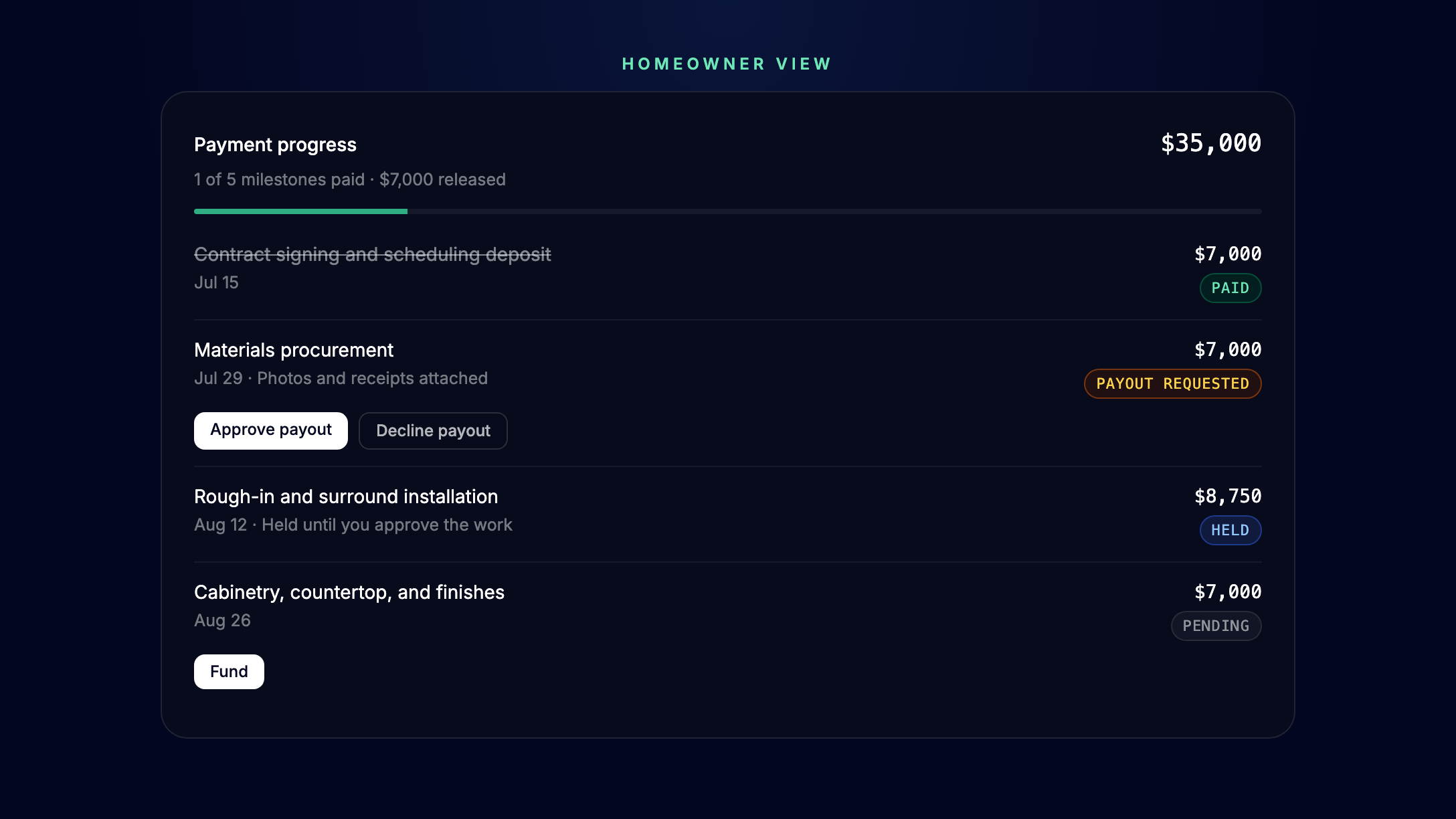
With a held payment, you fund a milestone but the contractor isn’t paid out yet. The money is committed, the contractor can see it’s real and waiting, but it isn’t released until you approve the completed work. It removes the two worst outcomes at once:
- You can’t lose a large deposit to someone who disappears, because nothing is released until work is approved.
- The contractor isn’t chasing you for payment after finishing, because the funds are already in place and release on approval, instead of waiting on a check or a net-30 cycle.
That balance is the point. Holding the payment isn’t about distrusting your contractor. It’s about removing the part of the relationship where trust is doing all the heavy lifting. Both sides know exactly where the money is and what triggers its release. That’s how RenovationRoute works: you fund each milestone, Stripe holds the contractor’s payout, and it is released when you approve the stage, or after our team reviews the record if you don’t answer for 14 days. (For more on why projects go sideways in the first place, see why home projects go wrong.)
Red Flags You Are About to Get Burned
Watch for these before you pay anything:
- Pressure for a large cash deposit, especially cash specifically rather than check or card
- No written contract with a clear scope and payment schedule
- No license or insurance you can verify with your state
- A price far below every other bid, which often means a deposit grab or a plan to pad with change orders later
- Reluctance to tie payments to milestones, the clearest tell of all
Any one of these is a reason to slow down. Two or more is a reason to walk.
What to Do If It Goes Wrong
If you have already paid too much and the work has stalled, your options exist but they’re slow and expensive: document everything in writing, file a complaint with your state licensing board, pursue small claims court, or deal with a mechanics lien dispute. People recover money this way, but it takes months and it’s stressful.
Which is exactly why the strategy on this page is built around prevention. Small deposit, milestone schedule, pay only for finished work you can see, and keep the rest held until you approve it. Do those four things and the worst-case scenario mostly can’t happen to you.
The Short Version
- Keep your deposit small, 10 to 25 percent, and never pay the full amount up front.
- Split the price into milestones tied to real, visible progress, in writing.
- Release each payment only after you have seen that stage finished.
- Hold back a final retention until the punch list is done.
- Pay only for finished work, and keep the rest held until you approve it, not released on trust.
Paying a contractor safely isn’t about finding someone you can trust completely. It’s about setting up the payments so you don’t have to. When the money always stays a step behind the work, you keep control of your project from the first deposit to the final walkthrough.
Ready to run your next project this way? See how RenovationRoute works for homeowners or post your project and pay milestone by milestone, with held payments released on your approval, from day one.
Frequently asked questions
- How much deposit should I give a contractor?
- A deposit of 10 to 25 percent is normal for residential work, enough to cover initial materials and reserve the schedule. Be cautious of anyone asking for 50 percent or more up front, or for the full amount before work begins. The deposit should fund the start of the job, not the whole job.
- Should I pay a contractor before or after the work?
- After. Tie every payment to completed, inspected work. Pay a modest deposit to begin, then release each milestone payment only once that stage is finished and you have seen it. Never pay for work you have not been able to verify.
- What is a milestone payment schedule?
- It is a written plan that splits the total price into stages tied to real progress, for example demolition complete, rough-in complete, drywall complete, final walkthrough. You release each payment only when that stage is genuinely done, which keeps the money and the work moving together.
- Is holding payments until approval safe for home renovation?
- Yes. You fund each milestone when it comes due, and the money is held until you approve the completed work. The contractor can see the money is funded and committed, and you keep control of the release. It protects both sides.
- Should I use escrow to pay a contractor?
- For a large project, escrow through a licensed escrow company is a safe option. A neutral third party holds your money and pays the contractor when the conditions you both signed are met. It costs a fee and takes some paperwork. For most remodels, a small deposit and a milestone schedule where you only release payment for finished work gives you the same protection.
- What if my contractor takes the deposit and disappears?
- If you paid a large cash deposit with no protection, your options are limited and slow. They include small claims court, a complaint to your state licensing board, or a mechanics lien dispute. The better answer is prevention. Keep deposits small, tie payments to milestones, and keep each payment held until you approve, so money is never released for work that was not done.
- Should I pay a contractor for materials up front?
- Usually yes, within reason. Most contractors cannot start without deposit money to buy materials, so a normal 10 to 25 percent deposit that covers the first materials is standard and fair. Your protection is keeping that deposit small, not refusing it. The exception is big special orders like custom cabinets or windows, where it is reasonable to ask for delivery to your property or to pay the supplier directly before that larger amount is released.