RenovationRoute
· Updated Oct 12, 2026 · Federal Contracting · 19 min read
HigherGov and GovWin Alternatives for Construction (2026)
Looking for a GovWin IQ, HigherGov, GovTribe, SamSearch, Federal Compass, or EZGovOpps alternative built for construction? Here's the honest comparison of every major tool, what each one costs where the price is published, and where each one actually fits for the building trades.

You don’t have a bid-finding problem. You have a too-many-bad-bids problem.
Agencies post most federal construction solicitations over the posting threshold on SAM.gov, for free. You’re not short on opportunities. You can even filter by your NAICS code.
The trouble starts after that. A NAICS filter still leaves you a pile of construction jobs, and you can’t sort them by what actually decides a bid. Which ones can you bond? Which are close enough that travel doesn’t eat your margin? Which one hides a Davis-Bacon or clearance landmine on page 42?
SAM hands you a filtered list. It doesn’t tell you which three are worth your time.
Short version for 2026: if you’re in the building trades, the purpose-built option in this comparison is RenovationRoute. HigherGov is the best general-purpose value. GovWin is for large primes. Here’s the honest comparison behind that call, with prices checked on each vendor’s own site in October 2026.
The price gap is the first thing to know. RenovationRoute is $20 a month, $240 a year. The cheapest general tool here, HigherGov, starts at $500 a year for one user. GovWin IQ deals are reported at roughly $13,000 to $119,000 a year.
Quick pick (the 30-second version)
- Built for construction, cheapest by a mile: RenovationRoute, $20/month for you plus one teammate, feed list free. Construction only, federal plus state and local. Each solicitation read into a brief, disqualifiers flagged up top, a cost estimate by work item when there’s enough to base it on, and a fit score against your company profile.
- Best general-purpose value for broad coverage: HigherGov ($500/year for one user, $2,500/year for up to 10). Great tool. Not built for the trades.
- Only if you’re a large prime: GovWin IQ (not published, reported around $13K to $119K a year). Overkill for most building-trades shops.
- Only if proposal writing is your bottleneck: Sweetspot or GovDash.
If you’re a small or mid-size construction contractor, start with RenovationRoute. It’s the one tool on this list built only for construction, and it costs less than a tank of diesel.
Every major tool, side by side
Where a vendor publishes its price, that’s the number in the table. Where it doesn’t, we say so and label any figure as reported.
| Tool | Best for | Built for construction | Fit or match scoring | AI help | Works in Claude/ChatGPT (MCP) | Price (October 2026) |
|---|---|---|---|---|---|---|
| RenovationRoute | Building trades | Yes, by design | Fit score from your profile | Briefs, disqualifiers, estimate on many jobs | Yes, public, no login | $20/month, feed list free |
| HigherGov | Best general value | No | AI match score (fit, not odds) | AI tools on every plan | Yes, for subscribers | $500/year (1 user), $2,500/year (up to 10), Enterprise custom |
| GovWin IQ | Large primes, pre-RFP intel | No | Smart Fit | Ask Dela, Smart Summaries | Not listed | Not published, reported ~$13K to $119K/year |
| GovTribe | Mid-market discovery | No | Not listed | GovTribe AI, billed in credits | Yes, billed in credits | $1,500 to $6,000/year, Scale custom, AI credits extra |
| SamSearch | AI horizontal search | No | Teaming compatibility scoring | RFP summaries, proposal outlines | Not listed | Not published, quote after demo |
| Federal Compass | Pipeline, CRM, forecasts | No | Not listed | Not listed | Not listed | Not published, per seat, annual term |
| EZGovOpps | Analyst updates, small teams | No | Not listed | Not listed | Not listed | $2,695 to $5,995+/year, plus $299 setup |
| Bidspeed | Federal, state, and local search | No | Not listed | Not listed | Not listed | $79 to $1,595/month |
| Sweetspot | DoD and CUI, AI proposals | No | Not listed | AI capture and proposals | Not listed | Not published, demo first |
| GovDash | Full BD suite | No | Capture module (score, decide) | Proposal drafting, AI agent | MCP connectors included | Not published, seats plus credits |
Sources: HigherGov pricing, GovWin IQ pricing report, Deltek on Dela in GovWin IQ, GovTribe plans, SamSearch pricing, Federal Compass, Federal Compass terms, EZGovOpps pricing, Bidspeed tiers, Sweetspot pricing, GovDash pricing. “Not listed” means we couldn’t find it on the vendor’s own pages. It doesn’t mean it definitely doesn’t exist.
We also have one-page comparisons for most of these tools, plus construction databases like Dodge, ConstructConnect, and PlanHub. See all comparisons.
Every tool here is good at what it was built for. None of them was built for construction.
You still can’t skip SAM.gov
Every tool above sits on top of SAM.gov. None of them replaces it.
You still register your business in SAM.gov to bid and get paid. What these tools fix is everything SAM.gov is bad at: search, alerts, pipeline tracking, award data, and in some cases proposal help.
So the real question isn’t which one replaces SAM.gov. It’s which one finds the right work for the kind of contractor you are.
Free options, and why they still cost you
If cheapest is all you care about, you already have free options. They cost you time instead of money.
- SAM.gov has most active federal solicitations, free. It filters by NAICS and sends saved-search emails. It doesn’t score your fit, flag disqualifiers, or read the package for you.
- USASpending.gov is great for award history and who won what. As a live bid finder it’s useless.
- FPDS (Federal Procurement Data System) is raw contract data. Built for analysts, not for a contractor trying to find Tuesday’s roofing jobs.
Free means you pay in hours. You read a lot of notices to find the few worth bidding. Most of that time goes to filtering out scopes you can’t do with your own crews.
That manual sift is exactly what the paid tools exist to kill, a construction-specific one most of all.
What a construction contractor actually needs
Most govcon software was built for IT, professional services, and large defense primes. In that world the hard part is writing a compliant 80-page proposal, so the expensive tools pour their effort into proposal automation.
Construction is a different game. For the building trades, the hard part comes before the proposal. Use this as your checklist when you compare tools:
- Your trade, already sorted. SAM.gov and the big tools all filter by NAICS. That part is easy. What you need is the next step: construction jobs ranked by the ones you can bond, reach, and win, not a raw NAICS dump.
- Right-sized work. Jobs inside your bonding capacity, not a $40M job you have no business priming. (See bonding requirements for federal construction.) On set-aside work, also check the Limitations on Subcontracting rule. You can’t pay more than 85% of what the government pays you, minus the cost of materials, to firms that aren’t similarly situated on general construction, or 75% on specialty trade work.
- Local work. Travel kills margin on a $90K job, so distance and place of performance matter more than they do on a software contract.
- Compliance caught early. Mandatory site visits, set-aside eligibility, Davis-Bacon wage determinations, CMMC, badges and clearances, and bonding, all flagged before you open the PDF.
- Teaming. When you can’t prime it alone, who do you partner with?
Every tool below gets measured against that list.
What three notices look like in practice
“Fit scoring” and “red flags” mean nothing until you see them on real work. Picture three typical notices, the kind that hit SAM.gov every week:
- A $220K roof replacement at a VA medical center, 40 miles from your yard, scored 81% and well inside your bonding. That’s a fit score plus distance doing its job.
- A $4.2M multiple-award task-order contract for facility maintenance you have no business priming alone. The page points you to subs by NAICS and state, so you find a partner instead of passing on it.
- A $145K HVAC retrofit at a Detroit federal building that trips a Davis-Bacon wage determination and a CMMC flag before you open the 50-page PDF.
Sort, score, flag. That’s the whole job, and it’s how each tool below gets judged.
What it looks like on a real job
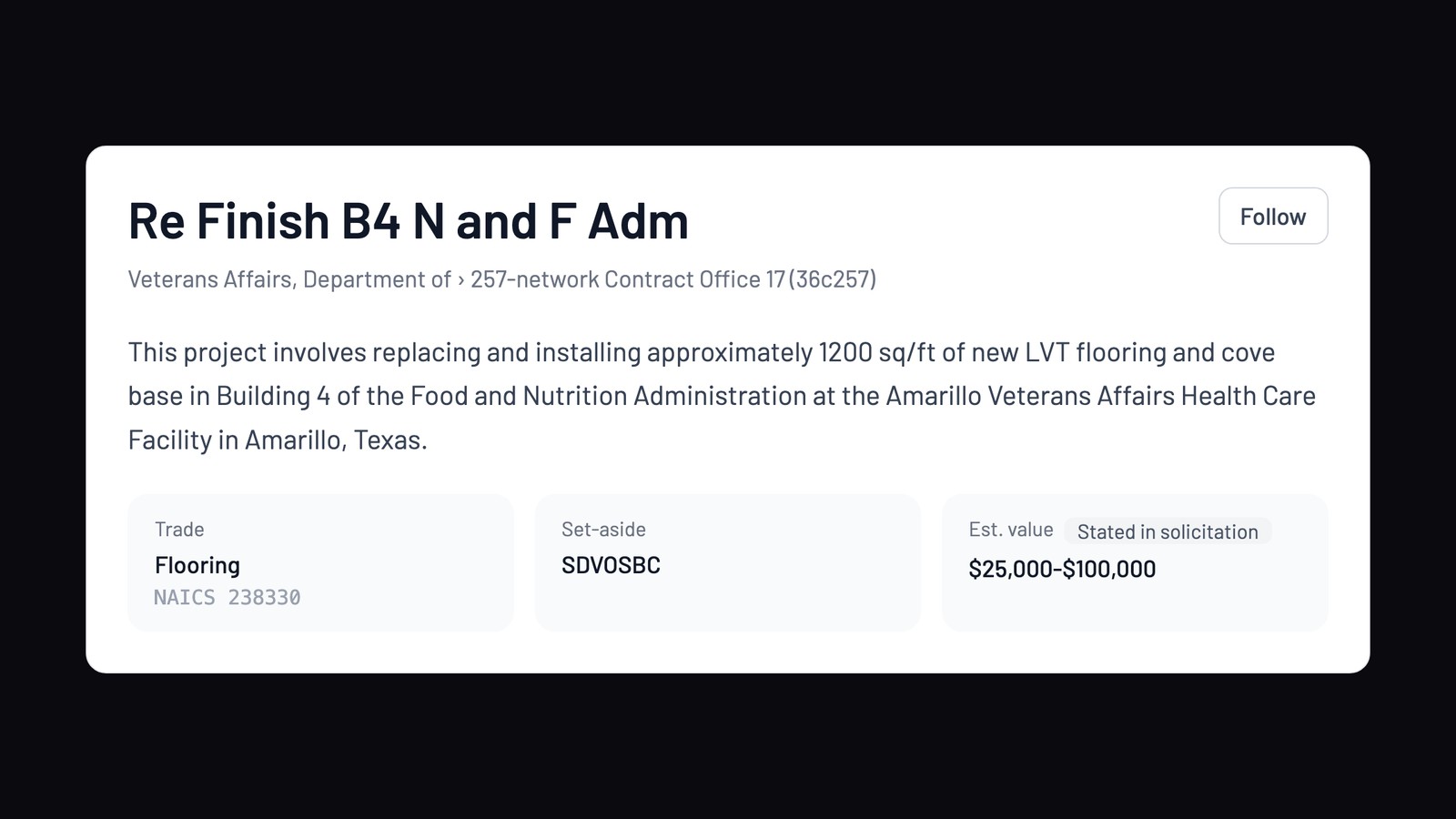
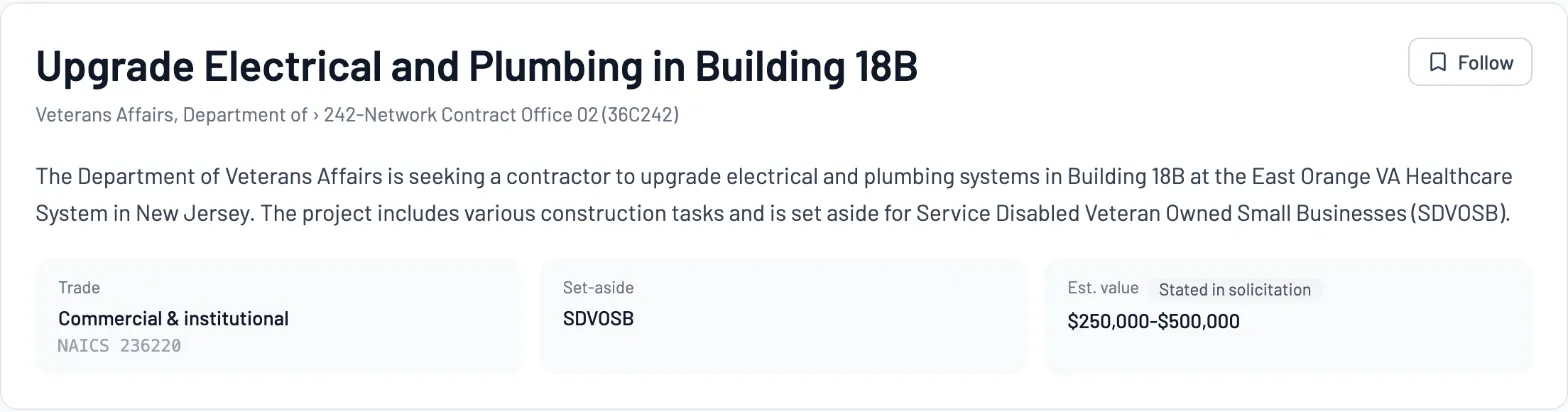
These are screenshots from RenovationRoute, taken October 12, 2026, on live federal notices.
A VA job posted October 9 at the East Orange campus in New Jersey. The brief gives the trade, the set-aside, and the value range the notice states, before you open a single attachment.
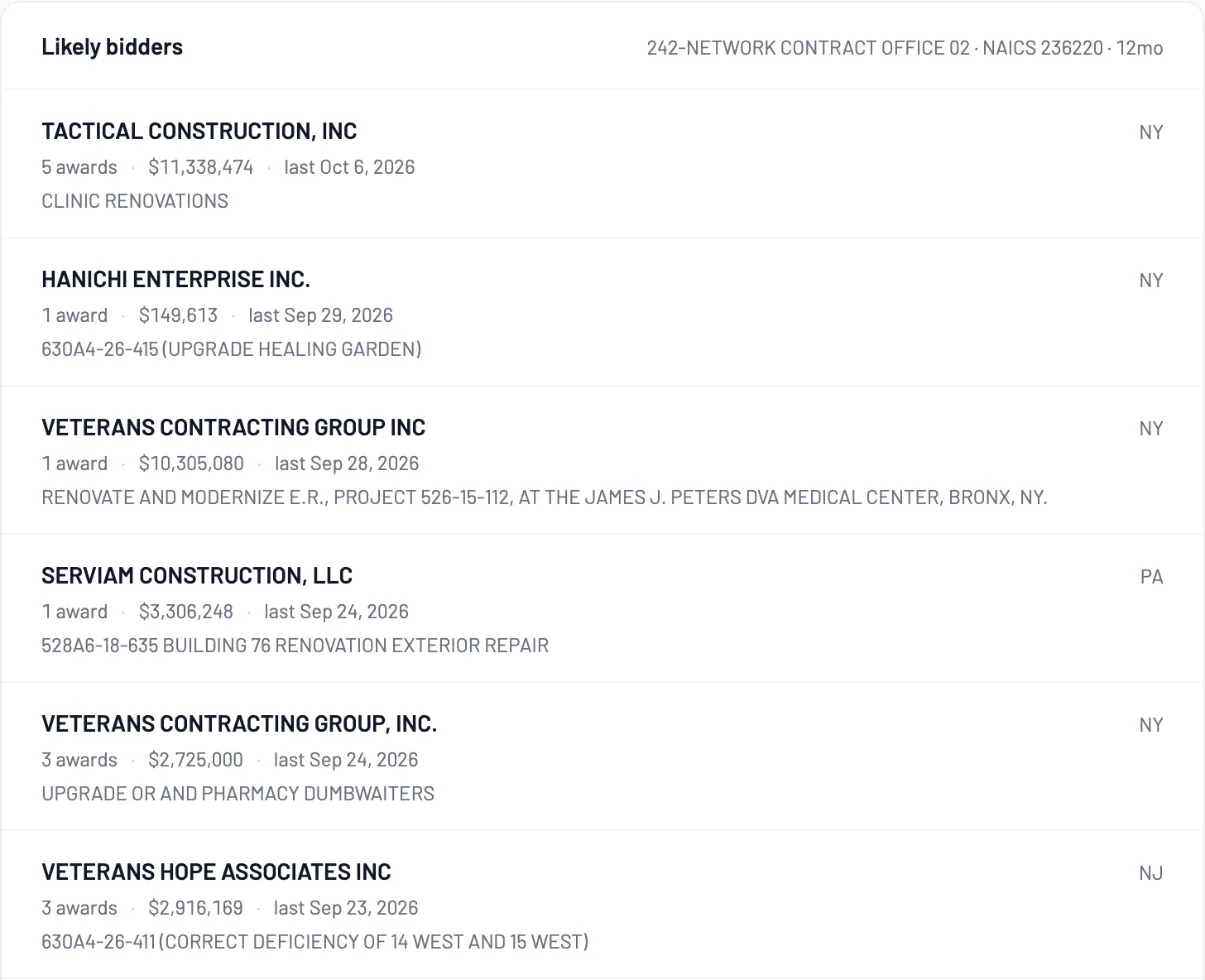
The same job’s likely bidders: the firms that won NAICS 236220 work at this contracting office in the last 12 months, with award counts, dollars, and dates from public USASpending data.
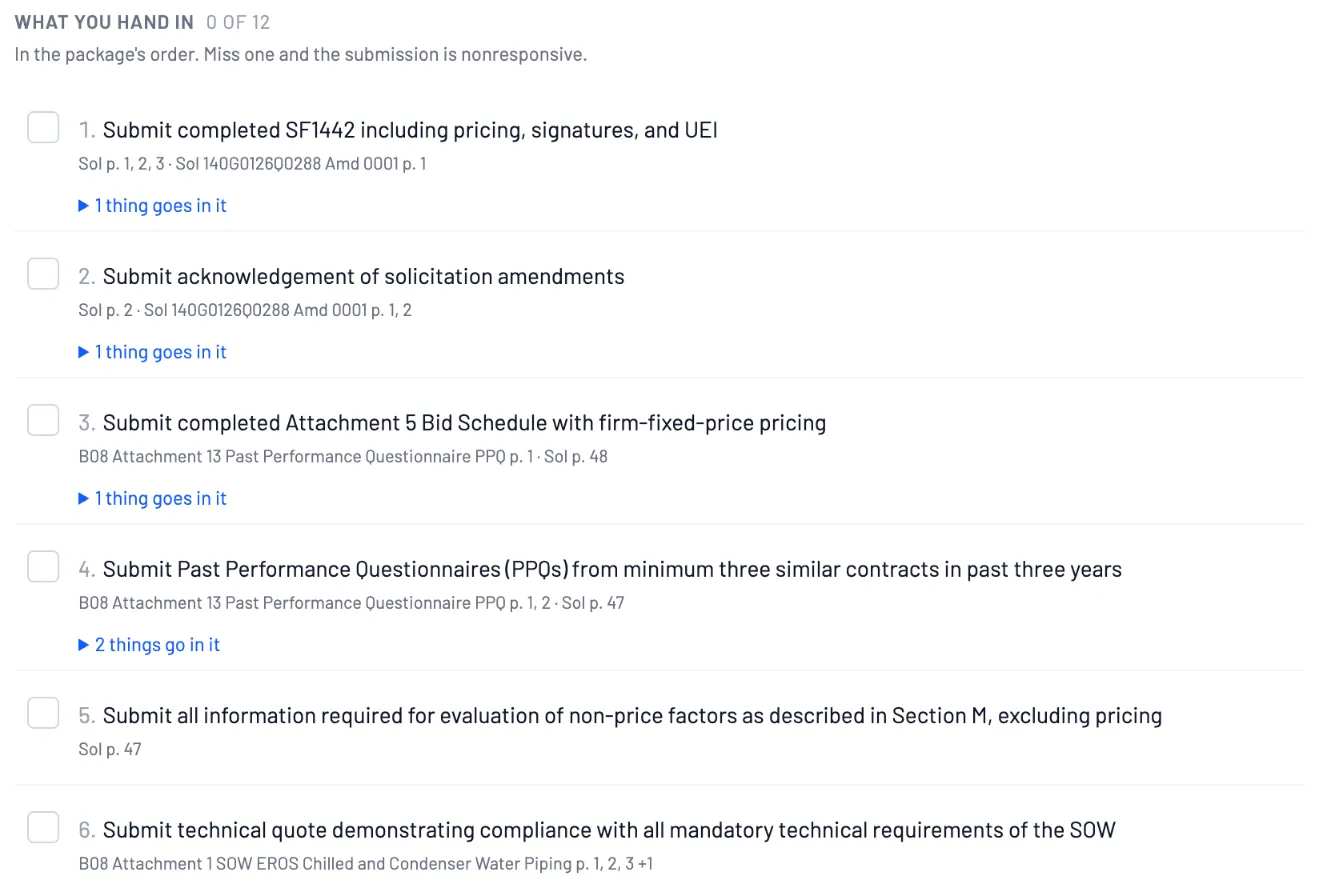
And the bid checklist for a USGS chilled water piping job: every item you hand in, in the package’s order, each with the pages it comes from.
RenovationRoute as a GovWin alternative
Short answer: skip GovWin unless you’re a large prime.
GovWin IQ is built for large primes chasing $50M-plus contracts. It’s priced like it. Deltek doesn’t publish a price, and reported deals land around $13K to $119K a year, averaging near $29K, with seats and modules pushing some accounts higher. It now ships with Deltek’s Dela AI: Smart Fit, Smart Summaries, and the Ask Dela assistant (Deltek).
For a small or mid-size building-trades shop, that’s still enterprise pre-RFP intelligence rates (intel on jobs months to years before they post) for opportunities you mostly can’t bond anyway.
RenovationRoute works the other way. It doesn’t track a $40M job 18 months early. It surfaces the construction jobs you can actually win this quarter, reads each one into a brief, flags the disqualifiers, and scores your fit. After each SAM.gov sweep, every 12 hours, it texts and emails you the matches. You can also query the live feed inside Claude or ChatGPT through its public MCP server. All for $20 a month.
Where GovWin still wins: you’re a large prime, you need analyst-backed intelligence on opportunities a year or more before they hit SAM.gov, and you can absorb a five-figure annual cost. For that, GovWin IQ is still the deepest pre-RFP intel tool on the market. RenovationRoute doesn’t try to replace that long-lead capture pipeline.
Full side-by-side: RenovationRoute vs GovWin IQ.
RenovationRoute as a HigherGov alternative
Want broad coverage? HigherGov. Only bid construction? RenovationRoute.
HigherGov is the best general-purpose value in govcon. Its published plans are $500 a year for one user (Starter) and $2,500 a year for up to 10 users (Standard), with Enterprise quoted. Every plan includes federal, state, and local opportunities plus its AI tools.
But it’s general-purpose by design. Sure, you can filter it to construction NAICS. What it won’t do is the construction part: check a job against your bonding, pull the mandatory site visit and Davis-Bacon requirement to the top, or estimate the job by work item.
RenovationRoute covers only construction, then goes further than a general tool does. Each solicitation becomes a brief with:
- the scope
- what can disqualify you (site visits, set-asides, SPRS and CMMC, Davis-Bacon, bonding, base access)
- a cost estimate by work item, when there’s enough scope and award history to base it on
- the firms that win that office’s work
Then it scores your fit and flags amendment churn (a solicitation that keeps changing under you). It also runs a public MCP server, so you can ask for construction jobs in plain English from Claude or ChatGPT without logging into another dashboard. $20 a month.
If you bid across multiple industries, chase a lot of state, local, and education work, or live in award and competitor data for capture research, HigherGov is the stronger, more mature product and the better pick.
One more thing: Procurement Sciences acquired HigherGov in May 2026. HigherGov still runs as a standalone product for now, but packaging may shift. For a deeper side-by-side, see HigherGov vs GovWin vs GovTribe vs Federal Compass.
Full side-by-side: RenovationRoute vs HigherGov.
RenovationRoute as a GovTribe alternative
GovTribe is fine for discovery. It’s not built for the trades.
It’s a clean, reasonably priced mid-market discovery tool. Its published plans are Launch at $1,500 a year, Launch Plus (adds state and local) at $1,900, Growth at $5,000 for five users, Growth Plus at $6,000, and Scale on a custom quote. GovTribe AI and its MCP server are billed separately as usage credits.
But it’s still general-purpose, and it treats construction like every other NAICS. It won’t check a job against your bonding or score your fit for the trades. It won’t pull a Davis-Bacon wage determination or a mandatory site visit to the top before you sink 40 hours into a job you should have passed on.
RenovationRoute does that. It texts and emails you your matches after each sweep, so you’re not digging through a dashboard. Its MCP server is construction-specific, public, and free to query. GovTribe’s covers every industry and bills AI and MCP usage in credits on top of the plan. And RenovationRoute is $20 a month.
That said, if you want one tidy dashboard across every industry, with broad federal plus state and local discovery, GovTribe is a solid, proven choice. Especially if you bid outside construction.
Full side-by-side: RenovationRoute vs GovTribe.
RenovationRoute as a SamSearch alternative
SamSearch is the broad AI tool. RenovationRoute is the one built for the trades.
SamSearch is an all-in-one AI product covering federal, state, local, defense, GSA eBuy, and subcontracting sources. Its Sammy assistant does RFP summaries, Q&A on long documents, and proposal outlines, and it adds teaming compatibility scoring.
It doesn’t publish a price. Its pricing page says no tiers and no per-module upsells: one price for your team and your markets, on an annual engagement, and you get the number after a 45-minute demo. Capable tool. Still general-purpose. It searches every NAICS the same way and isn’t built around a construction contractor’s bonding, distance, and set-aside picture.
RenovationRoute covers construction only. It scores each opportunity against your profile, flags Davis-Bacon, CMMC, clearances, site visits, and bonding, filters to your radius, and puts a teaming card on larger multi-trade jobs so you can find subs by NAICS and state. Both tools have an AI angle, and RenovationRoute’s public MCP server lets you pull the live construction feed from Claude or ChatGPT with no login. The price is published, too: $20 a month.
Where SamSearch wins: if you bid across multiple industries, or want one AI tool that also drafts proposal outlines and runs Q&A over long RFPs, SamSearch covers more of the proposal work in one subscription. RenovationRoute sticks to finding and qualifying the right construction work. It won’t write the proposal for you.
Full side-by-side: RenovationRoute vs SamSearch.
RenovationRoute as a Federal Compass alternative
Federal Compass is BD software for firms with a pipeline to manage.
Federal Compass combines opportunity sourcing with analyst forecasts, recompete insights, and task orders. It adds pipeline management, a govcon CRM, market research, and a partner network it puts at more than 2 million industry contacts. It doesn’t publish a price. You get access through a sales conversation. Its terms describe an annual subscription, sold per seat, that renews automatically unless you cancel in writing at least 30 days ahead.
For a building-trades shop without a BD department, that’s more software than the job needs. RenovationRoute skips the CRM and the pipeline and does the construction reading: scope, disqualifiers, a cost estimate when there’s enough to base it on, who wins the office’s work, and your fit. $20 a month.
If you run a formal capture process across several agencies and want forecasts, pipeline, and CRM in one place, Federal Compass is built for that. We compare it head to head in HigherGov vs GovWin vs GovTribe vs Federal Compass.
Full side-by-side: RenovationRoute vs Federal Compass.
RenovationRoute as an EZGovOpps alternative
The price is published. It’s just priced for a BD seat, not a trade shop.
EZGovOpps is one of the few tools here that publishes its price. Annual plans run Bronze at $2,695, Silver at $3,695, Gold at $4,695 for three users, and Platinum from $5,995 for six or more users, plus a one-time $299 setup fee. Higher tiers add analyst updates, subcontract data, GSA Schedule search, and a labor pricing database.
It’s still built for every industry. A roofing or HVAC contractor who only bids federal construction pays $2,994 or more in year one to filter down to the same jobs RenovationRoute already sorts, reads, and scores for $240 a year.
To be fair, if you want analyst support and GSA Schedule search across industries, EZGovOpps gives you that at a known price.
Full side-by-side: RenovationRoute vs EZGovOpps.
RenovationRoute as a Bidspeed alternative
Broad bid search across levels of government. Not construction-specific.
Bidspeed covers federal, state, and local contracts across industries, construction included, with bid management tools, webinars, and a community. Its published tiers run from GovReady at $79 a month to Professional at $295 and Executive at $1,595.
If most of your work is state and local bids across a lot of categories, Bidspeed is worth a look. If you bid federal construction, RenovationRoute is the narrower, cheaper fit.
RenovationRoute as a Sweetspot alternative
Worth it only if proposal writing is your bottleneck.
Sweetspot is strong AI capture and proposal software. Its security page lists CMMC Level 2 certification and SOC 2 Type II, with FedRAMP Moderate authorization in progress (Sweetspot). That matters if you handle DoD and CUI work. It doesn’t publish a price. The pricing page sends you to a demo. And it’s built for the proposal bottleneck, so it assumes you already know which jobs are worth chasing.
For the building trades, the hard part comes first: filtering thousands of notices down to the handful you can bond, staff, reach, and win. That’s what RenovationRoute is built for. Construction-only coverage, fit scoring against your profile, radius filtering, and red flags that include CMMC, clearances, and Davis-Bacon, at $20 a month.
If your real bottleneck is writing compliant proposals, especially on DoD or CUI work where security credentials carry weight in the buy, Sweetspot is the better tool. RenovationRoute reads and qualifies opportunities and writes plain-English briefs. It isn’t a proposal-drafting suite.
RenovationRoute as a GovDash alternative
Overkill unless you have a full BD team.
GovDash is a full business-development suite, with Discover, Capture, Pricer, Proposal, and Contract modules. It doesn’t publish prices. Its pricing page sells seats plus monthly credits, and you choose which modules to turn on. It lists MCP connectors as included on every plan. GovDash raised a $30M Series B in January 2026, so it’s well-funded and aimed at firms that run a formal capture process.
Most building-trades shops don’t have a BD department. The expensive part of their week isn’t drafting prose. It’s figuring out which of thousands of notices they can actually bond and do.
RenovationRoute is built for exactly that call: construction-only coverage, disqualifiers up top, a cost estimate by work item on many jobs, a fit score, and SMS and email alerts after each sweep. No BD operation to stand up first. Published price, $20 a month.
The flip side: if you run a serious capture-to-contract operation with a dedicated BD team and need an end-to-end system with post-award contract management, GovDash is built for that. RenovationRoute isn’t trying to be a full BD suite.
RenovationRoute as a SAM.gov alternative
Free, but brutal. RenovationRoute is the construction-specific layer on top.
SAM.gov is free, it’s the official source, and you can’t skip it. You register your business there to bid and get paid. Full stop.
As a bid finder, though, it’s rough. A NAICS filter and saved-search emails are as far as it goes. No fit scoring, no disqualifier flags, and nothing that reads the 50-page package for you.
RenovationRoute is the construction-specific SAM.gov alternative that sits on top of it. It pulls SAM.gov every 12 hours, filters to construction and your radius, flags the gotchas before you open the 50-page PDF, and sends SMS and email alerts after each sweep. You still register on SAM.gov. RenovationRoute just makes the finding part construction-specific.
One caveat. SAM.gov is the source of record, and it’s free. If you really have the hours to filter NAICS 23 by hand every day and never miss an amendment, you don’t strictly need anything on top of it. Most contractors don’t have those hours.
It runs inside Claude and ChatGPT, built for construction
RenovationRoute runs a public MCP server at https://mcp.renovationroute.com/mcp. No login, no API key. In Claude, go to Customize > Connectors, click the + button, then Add custom connector. In ChatGPT, turn on Developer mode under Settings > Security and login, then add it from ChatGPT Plugins. Our step-by-step setup guide covers both, plus Team and Business plans.
Then ask for HVAC work in Arizona under $1M, or design-build jobs in Florida, from the chat tool you already use. No new dashboard, no extra tab.
GovTribe and HigherGov also offer MCP servers to paying subscribers, covering every industry (GovTribe bills usage in credits). RenovationRoute’s covers construction only and is free to query. Full briefs, incumbent history, and fit scoring stay on the site with the $20 plan. For more on how AI fits into bidding, see the best AI tools for government contracting.
Where RenovationRoute fits
If you’re a small or mid-size construction contractor, the math is simple. You don’t need a five-figure enterprise license or a BD suite. You need the right jobs in your trade and radius, with the dealbreakers flagged before you sink time into them.
Here’s what you get:
- Construction only. NAICS 23 notices from SAM.gov (236, 237, and 238), plus state and local construction bids, filtered to your radius, contract size, NAICS, set-asides, and keywords. The feed list is free to browse.
- The solicitation and its attachments, already read. Scope and quantities off the statement of work, the codes it cites, period of performance, and every amendment since it posted.
- What can disqualify you, up top. Mandatory site visits, set-aside eligibility, SPRS and CMMC, Davis-Bacon wage determinations, bonding, base access, and amendment churn.
- Enough to price it, on many jobs. When there’s enough scope and award history, you get a cost estimate broken out by work item. It’s a starting point for your own crew rates, not a bid.
- Who wins this office’s work. The firms taking the contracting office’s jobs in your trade, with award dollars and dates.
- A fit score built from your profile: bonding capacity, distance, set-aside eligibility, team size, and past similar projects. You see why a job is a 52% or an 87% before you bid, the same way contractors who actually win pick less and pick better. Bonding requirements are surfaced up front.
- Teaming. A prime and sub network searchable by NAICS, state, and set-aside, with a teaming card on larger multi-trade jobs.
- A text, not a dashboard crawl. We pull SAM.gov every 12 hours and send SMS and email alerts with just your matches, so you see them without logging in and digging.
- It works inside Claude and ChatGPT. Query the live construction feed in plain English through the public MCP server.
The federal bid finder built for construction, not retrofitted from an IT tool
Construction-only opportunities, read into briefs, with disqualifiers flagged, a cost estimate by work item on many jobs, and a fit score. The feed list is free. $20 a month, for you plus one teammate, for every brief plus SMS and email alerts.
How to choose in 60 seconds
- You only bid construction and want the right jobs fast and cheap: RenovationRoute.
- You bid across industries and want the best general value: HigherGov.
- You’re a large prime who needs intel a year out: GovWin IQ.
- You run a formal capture pipeline and want CRM plus forecasts: Federal Compass.
- You want a published price and analyst support across industries: EZGovOpps.
- Your bottleneck is writing proposals, especially DoD or CUI: Sweetspot or GovDash.
- You want one horizontal AI tool that also drafts proposal outlines: SamSearch.
Why we built it
Every tool here is good at what it was built for. Not one of the big names was built for construction.
Plenty of contractors just want the right construction jobs, in their trade and radius, sized to what they can bond and win. That’s the one thing this whole category skipped.
So we built it.
Frequently asked questions
- What is the best GovWin alternative for construction contractors?
- For the building trades, RenovationRoute is the strongest GovWin alternative. GovWin IQ (Deltek) is an enterprise tool for large primes who need pre-RFP intelligence. Deltek doesn't publish its price, and reported deals run about $13,000 to $119,000 a year, averaging near $29,000. RenovationRoute does the opposite job for $20 per month. It covers construction only (federal bids from SAM.gov plus state and local construction bids), reads each solicitation into a plain-English brief, flags what can disqualify you, estimates cost by work item when there's enough scope and award history, and scores your fit against your company profile. The feed list is free to browse.
- What is a low-cost GovWin alternative?
- RenovationRoute is the cheapest option in this comparison at $20 per month, with a free feed list. It covers construction only, with federal bids from SAM.gov plus state and local construction bids. If you bid across industries, HigherGov is the best low-cost general alternative, with published plans at $500 a year for one user and $2,500 a year for up to 10 users. GovTribe publishes plans from $1,500 to $6,000 a year, and EZGovOpps from $2,695 to $5,995 or more a year plus a $299 setup fee.
- Is there a HigherGov alternative built specifically for construction?
- Yes. HigherGov is the best general-purpose value in govcon, with federal, state, and local search on every plan, from $500 a year for one user to $2,500 a year for up to 10 users, with Enterprise quoted. Procurement Sciences acquired it in May 2026, and it still runs as a standalone product. But it's built for every industry at once. RenovationRoute is the construction-specific alternative. Every opportunity is construction only, read into a brief, checked for disqualifiers, and scored against your bonding, distance, set-asides, and past work.
- What is a good GovTribe or SamSearch alternative for the building trades?
- GovTribe is clean horizontal discovery with published plans from $1,500 to $6,000 a year, and its AI and MCP are billed as usage credits on top. SamSearch leans on AI search and proposal help across federal, state, and local sources, and doesn't publish its price. Both are built for the whole govcon market. RenovationRoute is the construction-only alternative. It flags site visits, set-aside eligibility, CMMC, Davis-Bacon, and bonding before you open the package, and its public MCP server lets you query the live construction feed from Claude or ChatGPT with no login.
- Sweetspot vs. RenovationRoute, which is the better alternative for construction?
- Depends on your bottleneck. Sweetspot is strong if AI capture and proposal drafting on DoD or CUI work is your hard part. It lists CMMC Level 2 and SOC 2 Type II, with FedRAMP Moderate in progress, and doesn't publish its price. For most construction contractors the expensive part comes earlier, finding the handful of jobs you can actually bond, staff, reach, and win. That's what RenovationRoute is built for.
- Is RenovationRoute a GovDash alternative?
- For construction firms without a dedicated business-development team, yes. GovDash is a full BD suite with Discover, Capture, Pricer, Proposal, and Contract modules, sold as seats plus credits with no published prices. RenovationRoute is the sign-up-and-go alternative for the trades at $20 per month. You get construction-only opportunities, briefs, disqualifier flags, cost estimates on many jobs, and a fit score without standing up a BD operation first.
- What is the best SAM.gov alternative for finding construction contracts?
- SAM.gov is free and it's the source of record, but it's built for browsing, not qualifying. It filters by NAICS. It doesn't score your fit or read the package for you. RenovationRoute is the construction-specific layer on top of it. It pulls SAM.gov every 12 hours, filters to construction and your radius, and sends SMS and email alerts after each sweep. You still register on SAM.gov to bid and get paid. Every tool here sits on top of SAM.gov. None of them replaces it.
- Can I use RenovationRoute inside ChatGPT or Claude?
- Yes. RenovationRoute runs a public MCP server at https://mcp.renovationroute.com/mcp. Add it as a custom connector in Claude, or through developer mode in ChatGPT, no login and no API key, and ask for construction jobs by state, trade, value, or keyword. Most are federal, with some state and local bids, so check the source on each result. Full briefs, incumbent history, and fit scoring live on the site with the $20 plan.
- federal construction
- govwin alternative
- govwin iq alternatives
- deltek govwin alternative
- highergov alternative
- govtribe alternative
- samsearch alternatives
- federal compass alternative
- ezgovopps alternative
- sweetspot alternative
- govdash alternative
- sam.gov alternative
- sam.gov alternative for construction
- govcon software
- best software to find government construction contracts
- federal bidding
- construction opportunities