RenovationRoute
· Updated Sep 23, 2026 · Federal Contracting · 6 min read
DFARS 252.204-7021 and SPRS for Construction Contractors
DFARS 252.204-7021, SPRS scores, and CMMC are not just IT problems. If you bid DoD construction work, you need a score on file or your bid may never even get read.

Why this matters if you pour concrete instead of writing code
If you pour concrete, pull wire, or hang ductwork for a living, you probably do not wake up excited to read DFARS clauses.
Most contractors see DFARS 252.204-7021, CMMC, or NIST 800-171 in a solicitation, shrug, and mentally stick it in the “IT problem” bucket. Then they send in a solid proposal for a DoD job, never hear anything back, and assume they just lost.
In a lot of cases, the contracting officer never even looked at your price or your technical write up.
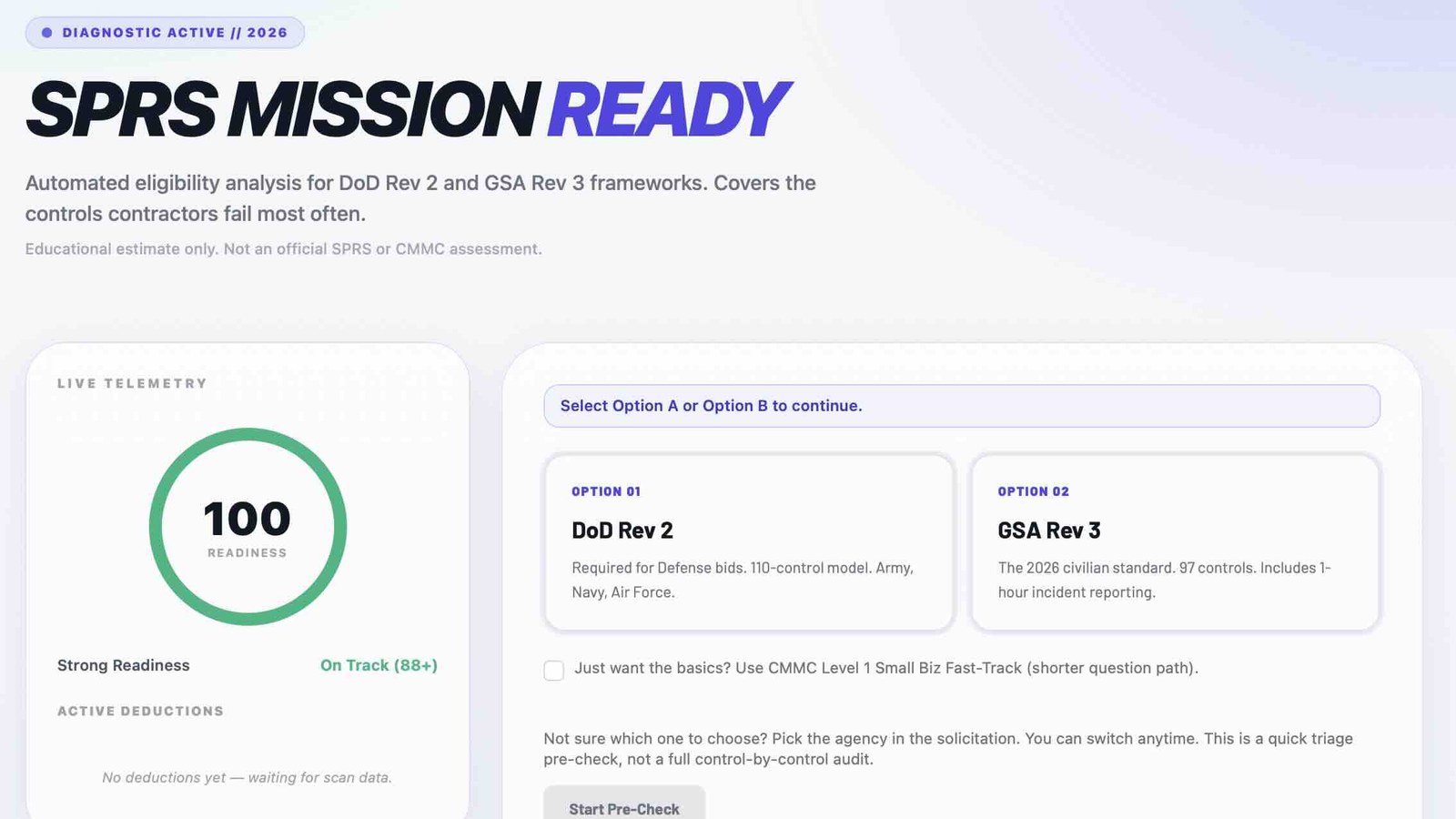
When DFARS 252.204-7021 shows up, the government expects you to have a cybersecurity self assessment on file in the Supplier Performance Risk System (SPRS) before award. Many offices now check for that before they evaluate offers at all.
No SPRS score on file means your bid can get filtered out before anyone opens your PDF.
This is not just an issue for IT primes. It hits builders, HVAC, paving, electrical, and every other NAICS 23 contractor that wants to do work for the Department of Defense.
The core requirement in plain language
Here is what DFARS 252.204-7021 and the current CMMC rollout really mean for most construction firms:
- You need an SPRS score on file tied to your CAGE code
- That score comes from a self assessment against NIST SP 800-171
- You need a basic, written security plan for how you handle information
- For higher risk work, someone outside your company may eventually need to verify it
If you ignore it, you do not usually get a fine in the mail. You just quietly miss out on awards you otherwise could have won.
What getting an SPRS score actually involves
There is a lot of noise and fear around CMMC. The practical work for a typical construction contractor is more boring than scary:
- Go through the 110 controls in NIST SP 800-171 and mark where you are today
- Score yourself on a scale from -203 up to 110 based on those controls
- Submit that score into the SPRS portal at sprs.us
- Write a System Security Plan (SSP) that explains how you protect information in real life
- Create a Plan of Action and Milestones (POA&M) for the gaps you still need to fix
You do not have to be perfect the first time. You do need to be honest, have a plan, and put a real score on record.
A few of the controls that trip contractors up
Most of the painful gaps are basic business hygiene, not advanced cybersecurity work:
- Laptops and phones used for DoD work are not encrypted
- Shared company email accounts have no multi factor authentication
- There is no written policy for who can access which systems and files
- Nobody owns the offboarding process when an employee or sub leaves
- Backups exist, but nobody has tested restoring the systems you actually use on jobs
Every missing control costs you points. Enough of them and your score can slide deep into the negative.
What this means in practice for a construction contractor
Here is how this plays out on real construction bids:
| Situation | Practical impact |
|---|---|
| You have no SPRS score filed | Many DoD offices treat you as ineligible. Your bid never makes it to technical review. |
| You have a very low (negative) score | You clear the paperwork step, but a contracting officer can see that your cyber posture is weak and move on to a stronger offeror. |
| You use a shared company email with no MFA | You fail multiple controls at once: access control, authentication, and account management. |
| You hand plans and specs to subs | Flow down applies. Those subs are supposed to meet the same basic requirements if they handle controlled information. |
| Work looks “purely physical” | You may still need CMMC Level 1 practices because you receive controlled information in email, drawings, and portals. |
None of this turns you into an IT company. It just forces you to treat your laptops, email, and file storage like real business systems instead of a pile of disconnected inboxes.
The October 31, 2026 date
A lot of articles talk about October 31, 2026 as a big circle on the calendar for CMMC. It is not a real deadline. The SPRS and self assessment requirements are already in force, and have been since Phase 1 began on November 10, 2025. What matters is which level your work falls under:
- CMMC Level 1: basic cyber hygiene practices for companies that handle Federal Contract Information. Most general construction work will live here.
- CMMC Level 2: stricter requirements for companies that handle Controlled Unclassified Information. This is where sensitive facility plans, infrastructure layouts, and critical systems show up.
Third party assessments from a C3PAO for Level 2 contracts were set to start with CMMC Phase 2 on November 10, 2026. On July 13, 2026 the Department of War suspended Phase 2, along with Phases 3 and 4, and launched a 60-day review by a CMMC Reform Task Force. The task force sent its report to the Department of War CIO around September 11, 2026. As of September 23, 2026 it has not been made public, and results are expected in late September or early October 2026.
The pause does not touch your self assessment. DFARS 252.204-7012, NIST SP 800-171 Rev 2, your SPRS score, and the annual affirmation all still apply. If you think your work will ever touch Level 2 projects, keep preparing now. Those assessments cost real money and time, and you do not want to start from scratch when they come back.
Most day to day construction firms will sit at Level 1 for a long time. That still means you need to do the self assessment, shore up the basics, and post your SPRS score.
A simple starting checklist
If you want to get moving without turning this into a full time job, here are five concrete steps:
- Confirm whether you have a CAGE code and an SPRS account
- Run a quick gap check on the obvious items: MFA, encryption on laptops and phones, offboarding, backups
- Block time to work through the NIST 800-171 self assessment instead of trying to do it in five minute chunks
- Write a short, honest System Security Plan that reflects how you handle information today, not how you wish it worked
- Post your SPRS score and keep a POA&M that lists what you will fix next and when
You will not check every box overnight. You will be far ahead of most small construction firms that are still pretending DFARS 252.204-7021 does not apply to them.
Where RenovationRoute fits
RenovationRoute is not a CMMC tool and it does not handle your compliance paperwork for you. Its job is to help you see which federal construction opportunities fit your business.
Inside RenovationRoute Federal Ops you can:
- See when an opportunity calls out CMMC or other higher security requirements before you sink time into a bid
- Filter and focus on work that matches your profile instead of chasing every posting that hits SAM.gov
If you need hands on help with DFARS 252.204-7021, CMMC, or NIST 800-171 itself, work with a specialist. Check out, MSTechAlpine, who helps contractors understand and implement these requirements so they can qualify for the work they want.
If you want to see how much federal construction work is actually available while you think through DFARS and CMMC, visit the live federal construction stats dashboard to see current opportunity counts by agency and NAICS 23.
Want federal work without surprises?
Use RenovationRoute to keep scopes, approvals, and payments in one place so you can focus on meeting the requirements that actually win and keep DoD work.