RenovationRoute
· Federal Contracting · 8 min read
How to Read a Federal Solicitation Without Losing Your Mind
Federal solicitations are written by lawyers for lawyers. Here is how to cut through the jargon, find the parts that actually matter, and spot the red flags before you waste 40 hours bidding a job you cannot win.
Federal solicitations are not written for contractors. They are written by contracting officers following standard government formats, and most of those formats were designed decades ago by people inside large bureaucracies. The result is a 60-page PDF that buries the actual scope of work somewhere around page 34.
Most contractors either skip reading the full document and miss something critical, or read all 60 pages and still feel lost. Neither works. This post gives you a faster path. Learn what the sections mean, where to look first, and what to walk away from before you ever start building a number.
RFP, RFQ, IFB: What Type of Solicitation Are You Looking At
Before you read anything, know which type of document you have. They are not the same and the differences matter.
IFB (Invitation for Bid). This is a sealed bid process. The government awards to the lowest responsive, responsible bidder. Period. There is no scoring of your qualifications or approach. You submit a price, they open all bids, the lowest one that meets the requirements wins. Most straightforward construction work under MATOC or simplified acquisition thresholds uses IFBs. If you see “IFB” in the title, price is the only lever you have.
RFP (Request for Proposal). The government is evaluating your proposal on more than just price. You will typically be scored on technical approach, past performance, management plan, and price. These are more complex to respond to and take longer to prepare. Larger construction projects, design-build contracts, and anything where the government wants to evaluate qualifications will use an RFP.
RFQ (Request for Quotation). Usually used for smaller purchases, often under simplified acquisition thresholds. Less formal than an IFB or RFP. The government is getting quotes, not binding bids. Still take them seriously, but the response is typically simpler.
Know which one you have. That shapes everything else.
The Sections That Actually Matter
Federal solicitations use a standardized format called the Uniform Contract Format (UCF). It has sections labeled A through M. You do not need to read all of them with equal attention. Here is where to focus:
Section C: Statement of Work (or Performance Work Statement)
This is the most important section in the document. Section C describes exactly what the government wants built, renovated, or maintained. If the scope is vague here, that is either a problem with the solicitation or an intentional move that will cause you pain later. Read Section C first, read it carefully, and read it twice.
Section L: Instructions, Conditions, and Notices to Offerors
Section L tells you exactly how to submit your proposal. Page limits, required attachments, file formats, submission portal, deadline. If you do not follow Section L to the letter, your proposal can be declared non-responsive and thrown out without ever being evaluated. This is where a lot of contractors get eliminated before their numbers are even seen.
Section M: Evaluation Factors for Award
Section M tells you how the government will score your proposal and what matters most. If Section M says technical approach is more important than price, do not cut corners on your technical writeup to save an hour. If it says past performance is the top factor, your project experience writeup needs to be strong. Section M is your scoring rubric. Read it before you write a single word of your proposal. (Most small contractors who lose bids never opened Section M at all: see why you keep losing federal construction bids for what evaluators are actually scoring.)
Sections A, B, and D through K matter for compliance and contract administration, but you can skim those on first read and come back to specific clauses if questions come up.
Stop Reading Solicitations on Your Own
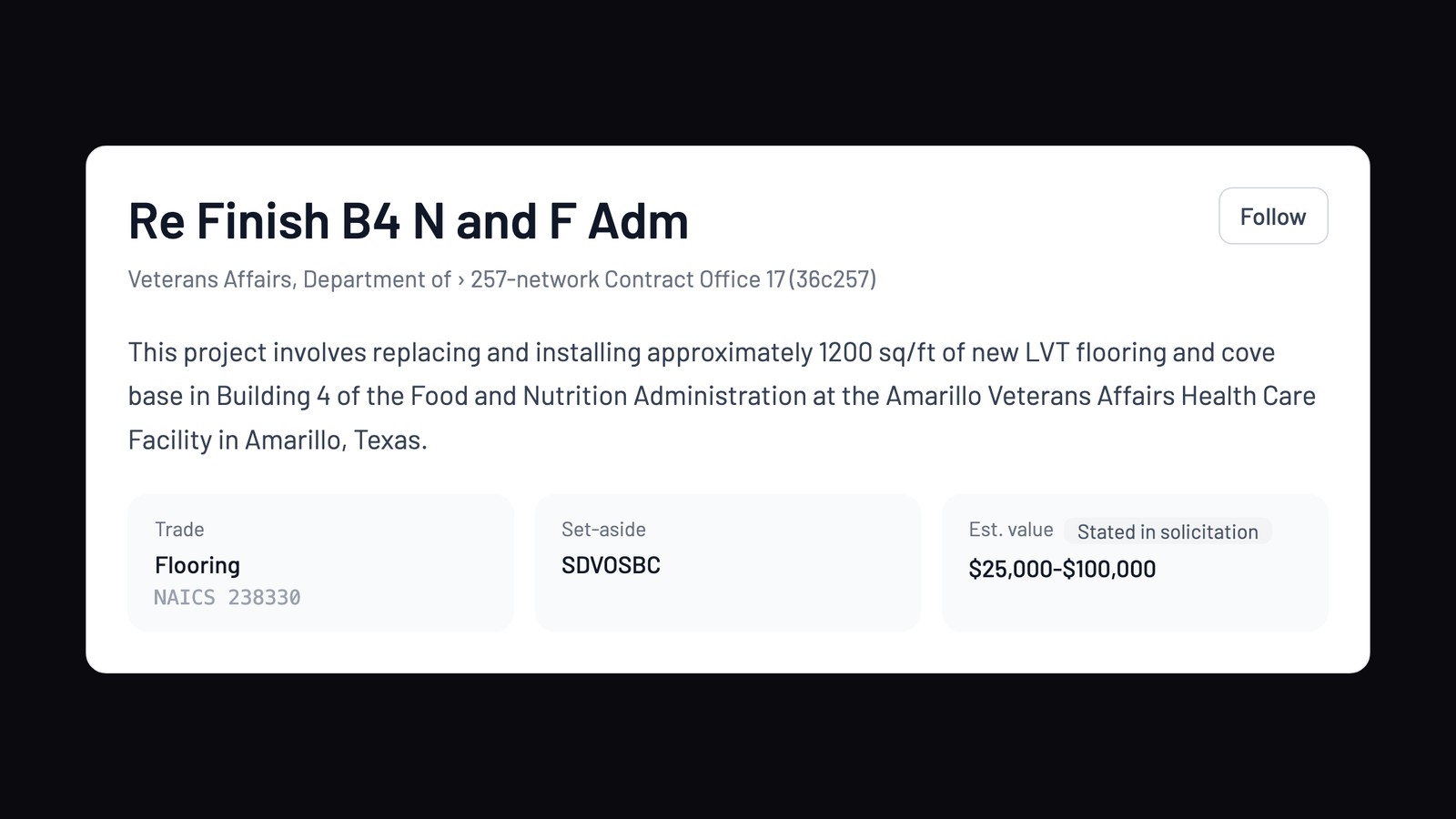
RenovationRoute pulls key scope details, compliance flags, and win probability from every SAM.gov opportunity before you open the PDF.
Where the Real Scope of Work Is Actually Hidden
Here is something that trips up a lot of contractors. The scope of work in Section C is often a summary. The actual scope lives in the attachments.
Solicitations frequently reference drawings, specifications, and technical documents either embedded as attachments in the download package or available through a separate link. You will see language in Section C like “see attached drawings” or “refer to Attachment A for technical specifications.” That is not boilerplate. Those documents contain the real detail your estimator needs.
Before you spend any time building a number, make sure you have all the attachments. Download the full solicitation package from SAM.gov, not just the base PDF. Check the attachments list. If something referenced in Section C is missing, contact the contracting officer and ask for it before the question deadline. That deadline is real. After it passes, they stop answering.
Also check for any incorporated-by-reference documents. Some solicitations pull in entire technical manuals or installation standards by reference. If your scope involves specialized systems, there may be a reference document that specifies exactly how the work must be done and it will not be obvious unless you read carefully.
Red Flags That Signal a Wired Bid
Not every solicitation is a genuine open competition. Some are written around a specific contractor the agency already has in mind. Bidding against a wired solicitation is not illegal, but it is almost always a waste of time. Here is how to spot them:
Hyper-specific experience requirements with no explanation. If a solicitation for a $180K roof replacement requires “a minimum of 10 years of experience with TPO roofing systems on DoD facilities greater than 50,000 square feet in the Mid-Atlantic region,” that requirement is almost certainly written to match exactly one contractor the agency already knows. Legitimate solicitations have reasonable experience requirements proportional to the scope. Unreasonably narrow requirements are a signal.
Unusual bonding thresholds. The Miller Act requires performance and payment bonds on federal construction contracts over $150,000. If a $200K contract has a $500K bonding requirement in the solicitation, pay attention. That threshold may be calibrated to eliminate small competitors.
Incumbent language. Watch for phrasing that heavily implies continuity of existing work. “Contractor must have familiarity with existing site conditions, current facility systems, and previously installed equipment” is not necessarily a red flag on its own, but combined with a short turnaround between solicitation and due date and a very specific scope, it often means the incumbent is expected to win.
Short question-and-answer windows. If a complex 60-page solicitation was posted with a 3-day window to submit questions and a 10-day window to submit proposals, the government is not seriously expecting new competitors. A legitimate competition gives bidders enough time to read, ask questions, get answers, and build a real proposal.
None of these individually mean a bid is wired. But when you see two or three of them together, think hard before committing 40 hours to a response.
Amendments: Why the Count Matters
Every federal solicitation shows you how many amendments have been issued since it was originally posted. An amendment is a change notice. It could be anything from a corrected date to a full rewrite of Section C.
Amendments happen for legitimate reasons. The government changed the scope, got questions from bidders that required clarifications, or had to extend the deadline. That is normal.
What is not normal is four, five, or six amendments on a mid-size construction solicitation. That many changes means one of two things. Either the original solicitation was poorly written and the agency is scrambling to fix it, or bidders raised serious objections and the government had to keep revising. Either way, proceed carefully.
When you see a lot of amendments, read every one of them, in order, before you read the base solicitation. Each amendment supersedes any conflicting language in the original. If you bid off the base document without reading the amendments, you are bidding off the wrong scope. This happens more often than you would think.
What Submissions Actually Require
Section L will tell you exactly what to submit. Read it like a checklist because that is exactly what the contracting officer uses to evaluate whether your submission is responsive.
Common required submissions for construction solicitations include:
- Bid/proposal form (usually SF-1442 or an agency-specific form)
- Unit price schedule or lump sum price
- Subcontractor plan (required on contracts over $750K)
- Past performance references (typically 3-5 relevant projects)
- Bonding commitment letter from your surety
- Technical approach narrative (for RFPs)
- Small business size certification (already in your SAM.gov registration)
Missing any one of these can get your submission thrown out before the price is even reviewed. Go through Section L line by line and build a checklist before you start writing anything.
Know What You're Getting Into Before You Start
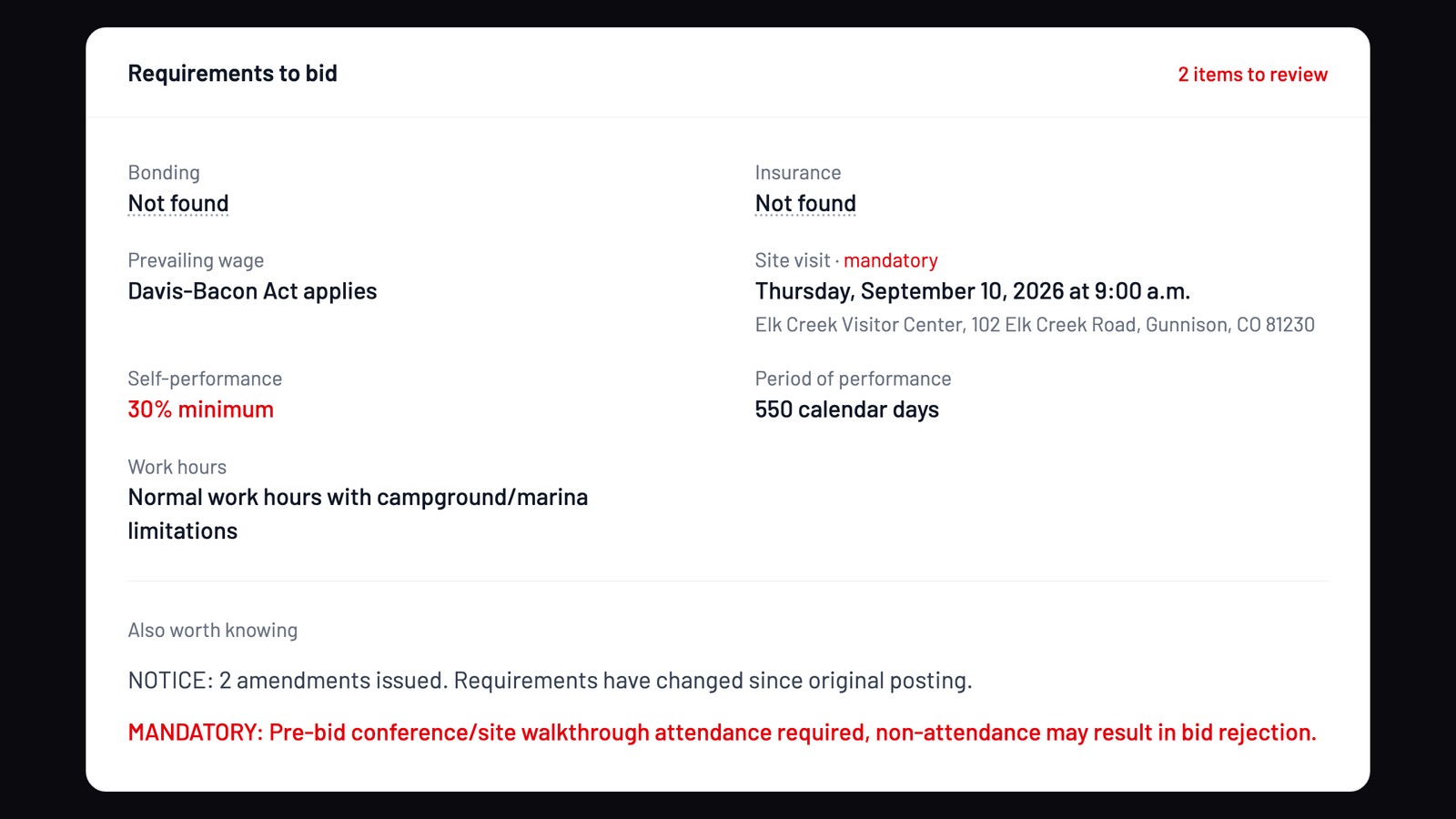
RenovationRoute flags compliance requirements, missing attachments, and amendment history on every federal opportunity so you can decide in two minutes whether it's worth bidding.
The Real Time Cost of Reading Federal Solicitations
A typical small construction contractor bidding federal work spends 6 to 10 hours reading a solicitation before they even start estimating. That is what it takes to understand a government document well enough to price it accurately and submit something compliant.
Now think about how many solicitations you evaluate in a month that you end up not bidding. Every one of those is unpaid reading time. That adds up fast, and it is one of the main reasons contractors quit federal work after six months.
The only fix is getting faster at the triage step. Figure out early whether something is worth a full read. Know which section to open first, what to look for in the first five minutes, and how to make a go or no-go call before you are three hours deep on something you were never going to bid.
That is what RenovationRoute is built for. It pulls the key scope details, compliance requirements, amendment history, and estimated competition level before you ever open the PDF. You still read the full solicitation on anything you decide to pursue. But you stop sinking hours into ones you should have skipped in the first two minutes.