RenovationRoute
· Contractor Guides · 7 min read
How to Get Paid as a Contractor: Deposits, Liens, Escrow
Getting stiffed is a structural problem, not bad luck. Here is how to set up deposits, progress billing, lien rights, and funded milestones so you get paid on time without chasing checks or financing your customers.
Every contractor has a story about the job that didn’t pay. The remodel where the homeowner kept finding reasons to hold the final check. The builder up the chain who went quiet on net-60. The customer who loved the work right up until the invoice arrived. It feels like bad luck, but it usually isn’t. Getting stiffed is almost always a structural problem, you let the amount you were owed get bigger than the leverage you had to collect it.
Fix the structure and the problem mostly goes away. Here is how to set up your deposits, billing, and payment protection so getting paid stops being the hardest part of the job.
Why Contractors Get Stiffed
It comes down to one thing: at some point you’re owed more than you can easily collect. You finished the work, the customer has it, and now the only thing standing between you and your money is their willingness to write a check. That’s a weak position, and the customer knows it.
The fix is to never be in that position. Keep the value of completed-but-unpaid work small at every stage, and keep your funds tied to progress the customer can see. Do that and you remove the leverage a slow-paying customer relies on.
Get a Deposit, Every Time
Starting a job with zero money down means you’re financing your customer from the first hour. Collect a deposit. For most residential work, 10 to 25 percent is standard and reasonable. It covers your initial materials and confirms the customer is serious.
Resist the urge to ask for much more. A huge up-front payment scares off exactly the well-funded, low-drama customers you want, may run past state deposit limits, and isn’t where your real protection comes from anyway. Your protection comes from how you bill the rest of the job.
Bill in Progress, Not at the End
Progress billing is the core of getting paid. Split the contract into milestones tied to completed, visible stages, and invoice each one as it’s finished:
- Deposit to start and order materials
- Demolition and rough-in complete
- Drywall and substrate complete
- Finishes and fixtures complete
- Final walkthrough and punch list
The discipline that matters: don’t let the work get far ahead of the payments. If you have completed rough-in and finishes but only collected the deposit, you’re now carrying the customer for most of the job, and you’re exposed. Bill each milestone as you complete it, and confirm the previous payment cleared before you sink labor and materials into the next stage.
This protects your cash flow too. You’re buying materials and making payroll against money that’s coming in along the way, not floating the entire project on your own line of credit and hoping the final check arrives. (On the federal side, where payment timelines are their own animal, see how long it actually takes to get paid on a federal contract.)
Mechanics Liens: the Backstop, Not the Plan
If you don’t get paid, a mechanics lien is your legal claim against the property for the value of the work you performed. It’s a real and powerful right, and you should always preserve it: know your state’s deadlines for preliminary notices and lien filings, and put a reservation of lien rights in your contract.
But understand what a lien is. It’s a cure, not a prevention. By the time you’re filing one, you have already done the work, already not been paid, and you’re now entering a slow, legal, adversarial process to claw money back. Liens recover money. They don’t give you back the months of stress and cash-flow damage in the meantime. Treat your lien rights as the backstop you hope never to use, not as your payment plan.
What About Escrow?
Escrow means a licensed third party, an escrow company, holds the customer’s money and pays you when the conditions in the escrow agreement are met. It works, and on big jobs some customers will ask for it. Expect paperwork, a written agreement about what counts as done, and a fee for the escrow company.
RenovationRoute is not an escrow company. If a customer wants real escrow, use a licensed escrow company. Most residential jobs don’t need it. Getting each milestone funded before you start it gives you the same leverage without a third party in the middle.
Funded Milestones: Get Paid When the Work Is Approved
The cleanest way to never be in the weak position is to have the customer’s money committed before you start each stage.
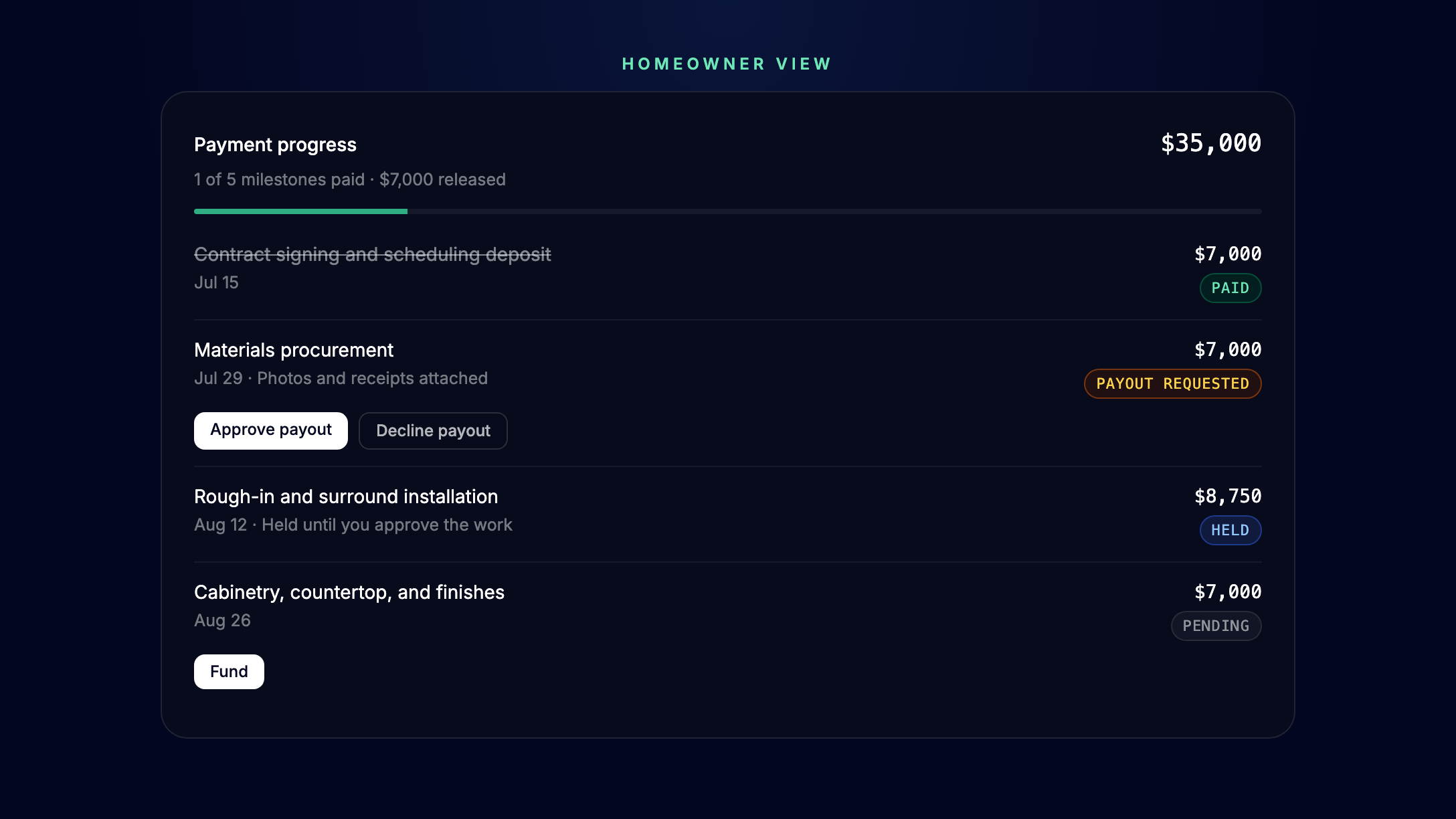
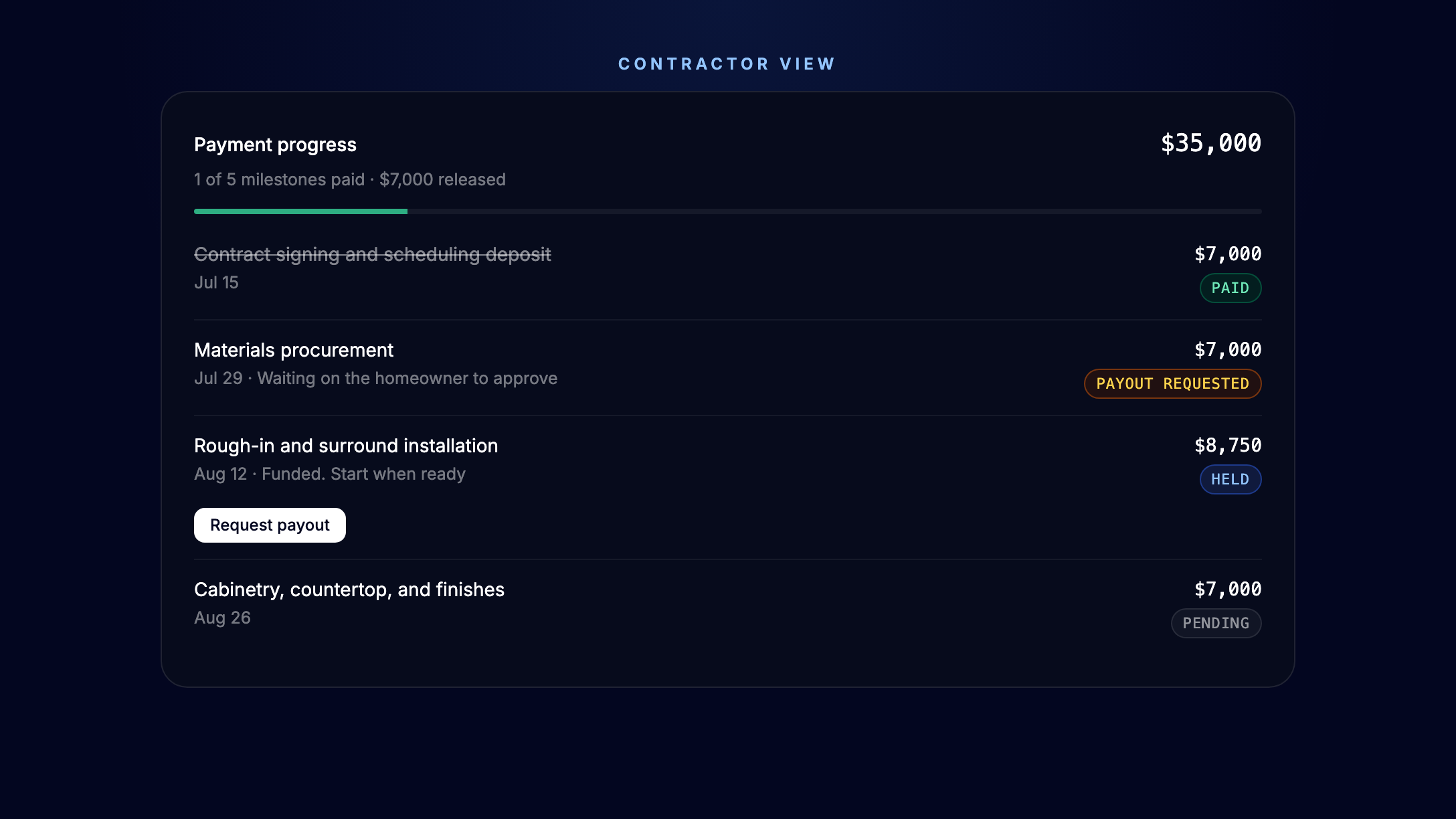
With funded milestones, the customer pays each milestone before you start it, and the money is held until they approve the work. You can see the money is there and committed. When you finish the milestone and the customer approves it, the funds release to you, instead of starting a net-30 clock or waiting on a mailed check. The work-then-chase cycle is gone.
Look at what that changes for you:
- You’re no longer financing the customer. Their money is already funded before your crew shows up.
- You’re not chasing payment after finishing. Approval triggers release.
- Disputes shrink, because both sides agreed to the milestones and the funds are tied to them, not to the customer’s mood when the invoice lands.
That’s how RenovationRoute works. Bids, scope, milestones, and payment all live in one place. The customer funds each milestone when it comes due, before you start work on that stage, and with a held payment your payout sits in Stripe until the customer approves, or, if a payout request goes unanswered for 14 days, until our team reviews the project record. Once you have a track record you can unlock Quick Pay, which skips the approval hold. It is not faster; both settle in 2 to 5 business days. The point is the same: you do the work and the money is already waiting, not somewhere down a 30-day pipe.
Payment Terms to Put in Every Contract
Before any job, your written agreement should spell out:
- The scope in plain terms, so “done” isn’t a matter of opinion
- The deposit amount and what it covers
- A milestone payment schedule tied to defined, inspectable stages
- The time the customer has to approve or reject completed work, so silence can’t stall your payment forever
- A late-payment provision with interest or fees
- A reservation of lien rights
The contract isn’t paperwork for its own sake. The single biggest predictor of getting paid without a fight is that the payment schedule was written down and agreed to before anyone picked up a tool.
The Short Version
- Take a deposit on every job, 10 to 25 percent, and start with money in hand.
- Bill in milestones as you complete them; never let unpaid work get ahead of your leverage.
- Preserve your lien rights, but treat them as a backstop, not a plan.
- Have the customer fund each milestone before you start it, and get it released when they approve.
- Put the deposit, milestones, and approval window in every written contract.
Getting paid isn’t about finding honest customers and hoping. It’s about structuring the job so an honest customer pays easily and a slow one runs out of leverage. Keep the money tied to the work, get it committed up front, and collecting stops being the hardest part of running your business.
Want to bid and get paid this way? See how RenovationRoute works for contractors or join as a contractor and run your next job on milestone payments, each one funded before you start that stage.
Frequently asked questions
- How do I make sure I get paid as a contractor?
- Structure the job so you are never financing the customer. Collect a deposit before you start, bill in progress milestones tied to completed work, and never let the amount you are owed get larger than the value of work still in your control. Funded milestones take this further. The customer pays each stage before you start it, and the money is released to you when they approve the work.
- What is a fair deposit to ask for as a contractor?
- A deposit of 10 to 25 percent is standard and reasonable for residential work, and it should cover your initial materials and reserve the schedule. Asking for much more can scare off good customers and may exceed state limits, so the better lever is progress billing, not a huge up-front payment.
- Are funded milestones or a mechanics lien better for getting paid?
- They solve the problem at different ends. A mechanics lien is a cure, it helps you recover money after you have already not been paid, and it is slow, legal, and adversarial. Funded milestones are prevention, the customer pays each stage before you start it and the money is released when they approve the work, so the non-payment mostly never happens. Use funded milestones to avoid the fight; keep lien rights as a backstop.
- Should I use escrow as a contractor?
- On a big job, or with a customer who wants it, escrow through a licensed escrow company works. A neutral third party holds the money and pays you when the conditions in the escrow agreement are met. Expect paperwork and a fee. On most residential jobs, a deposit plus milestones the customer funds before you start each stage gets you the same protection with less overhead.
- How do I avoid net-30 and chasing checks?
- Tie payment to completed milestones and use a system that releases funds on approval instead of on an invoice cycle. When the milestone is funded before you start it, the money is released to you when the customer approves it, rather than starting a 30-day clock.
- What payment terms should be in every contract?
- A clear scope, a deposit amount, a milestone payment schedule tied to defined stages, the timeframe for the customer to approve or reject completed work, a late-payment provision, and a reservation of your lien rights. Putting the payment schedule in writing before you start is the single biggest predictor of getting paid without a fight.