RenovationRoute
· Federal Contracting · 8 min read
The Best AI Tools for Government Contracting in 2026, and the One Built for Construction
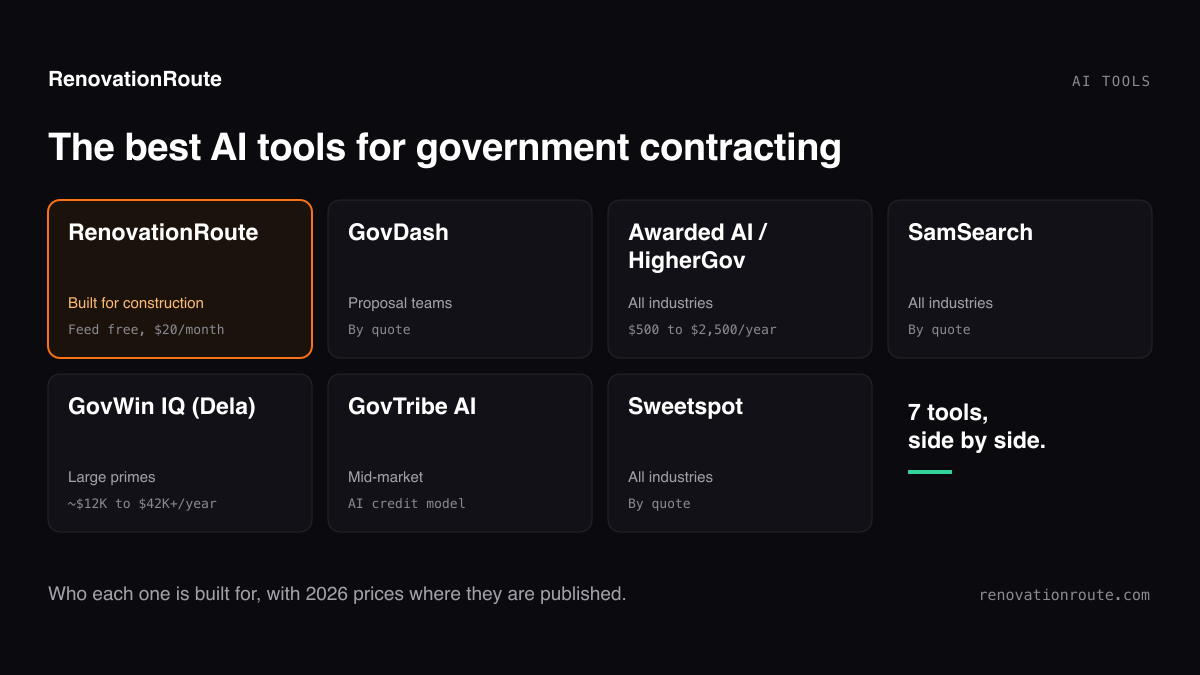
Every "best AI for GovCon" list is written for proposal teams. These are the AI tools that matter in 2026: what each one does, what it costs where the price is published, and which ones help a construction contractor who needs to read the package, not write 80 pages.
Search “best AI tools for government contracting.” The top result is a list written by an AI proposal company. That company is number one.
We read them all. Same three things every time:
- They’re built for proposal teams. The AI writes compliance matrices and 80-page technical volumes.
- Almost none publish a price. You book a demo to find out.
- None of them are about construction.
We make one of the tools on this list, so here’s our bias up front. RenovationRoute is first, because it’s the one built for construction contractors. For the rest, we tell you what each tool does and who should buy it. Including when you should buy something other than ours.
Why construction is different
For an IT contractor, the hard part of a federal bid is writing. Long technical proposals, graded on evaluation criteria. That’s what most AI GovCon tools are built to automate.
For a construction contractor, the hard part is reading. Many federal construction solicitations are sealed bids or price-driven quotes: every bidder that meets the requirements gets compared on price. Your prose isn’t what loses you the job. This is:
- A mandatory site visit you missed
- A set-aside you don’t qualify for
- Bonding you can’t get
- A Davis-Bacon wage determination that changes your labor number
- An amendment that moved the date or changed the scope
All of it is buried in the solicitation and its attachments. The AI that helps a construction firm is the one that reads the package, not the one that writes the proposal.
1. RenovationRoute: AI that reads the package, built only for construction
Best for: small and mid-size construction contractors who bid federal work without a business development team.
RenovationRoute reads the solicitation and its attachments for federal construction jobs on SAM.gov, plus some state and local bids, and turns them into something you can make a call on in minutes:
- A plain-English brief: scope and quantities from the statement of work, the codes it cites, period of performance, and every amendment since it posted.
- What can disqualify you, up top: mandatory site visits, set-aside eligibility, SPRS and CMMC, Davis-Bacon, bonding, base access.
- A cost estimate by work item when there’s enough scope and award history to base it on, built from that contracting office’s own awards, with aggressive, balanced, and conservative totals. It’s a starting point to price your crew against. It’s not a bid.
- Who wins this office’s work: the firms taking this office’s jobs in your trade, with award dollars and dates.
- A fit score based on your company profile.
- Change alerts ($20/month plan). Follow a job and you’ll hear about it when it changes.
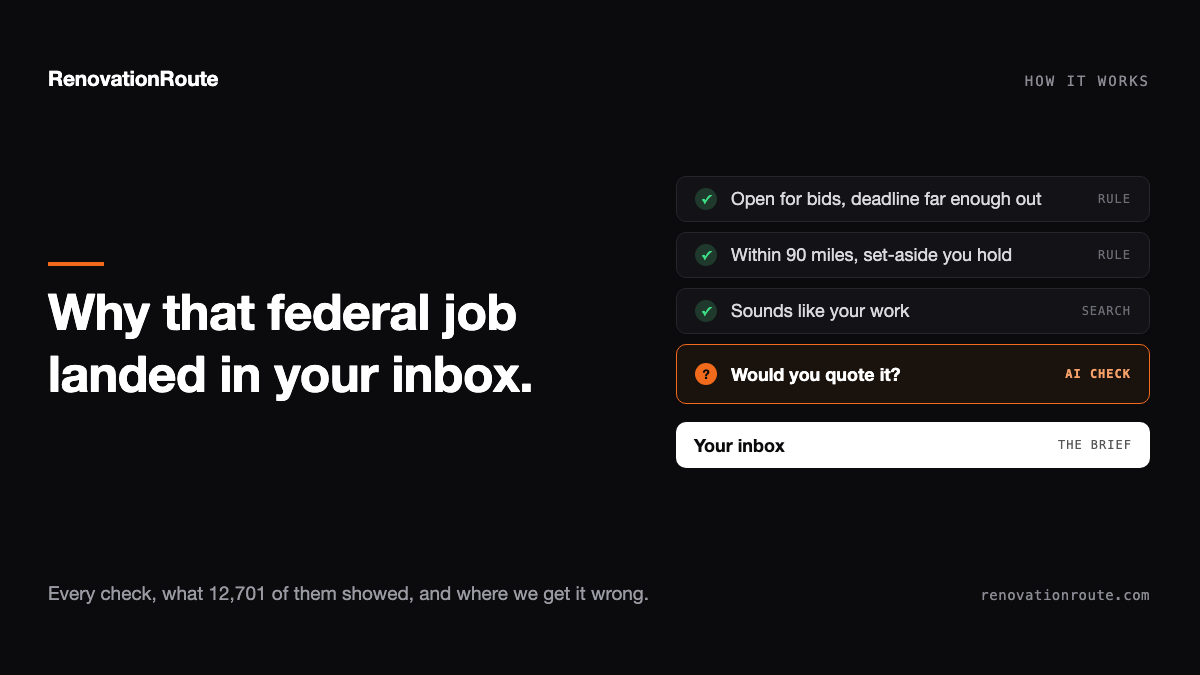
- A bid checklist (Pro). Code pulls every candidate requirement out of the package first, so the AI is sorting real text, not making up requirements. Then the AI sorts them into a checklist of every form, deadline, and gate, in two independent passes, and marks where the passes disagree. Any date, dollar amount, or number in its wording that doesn’t appear in the package gets flagged so you check it. Page numbers come from the documents, never from the AI.
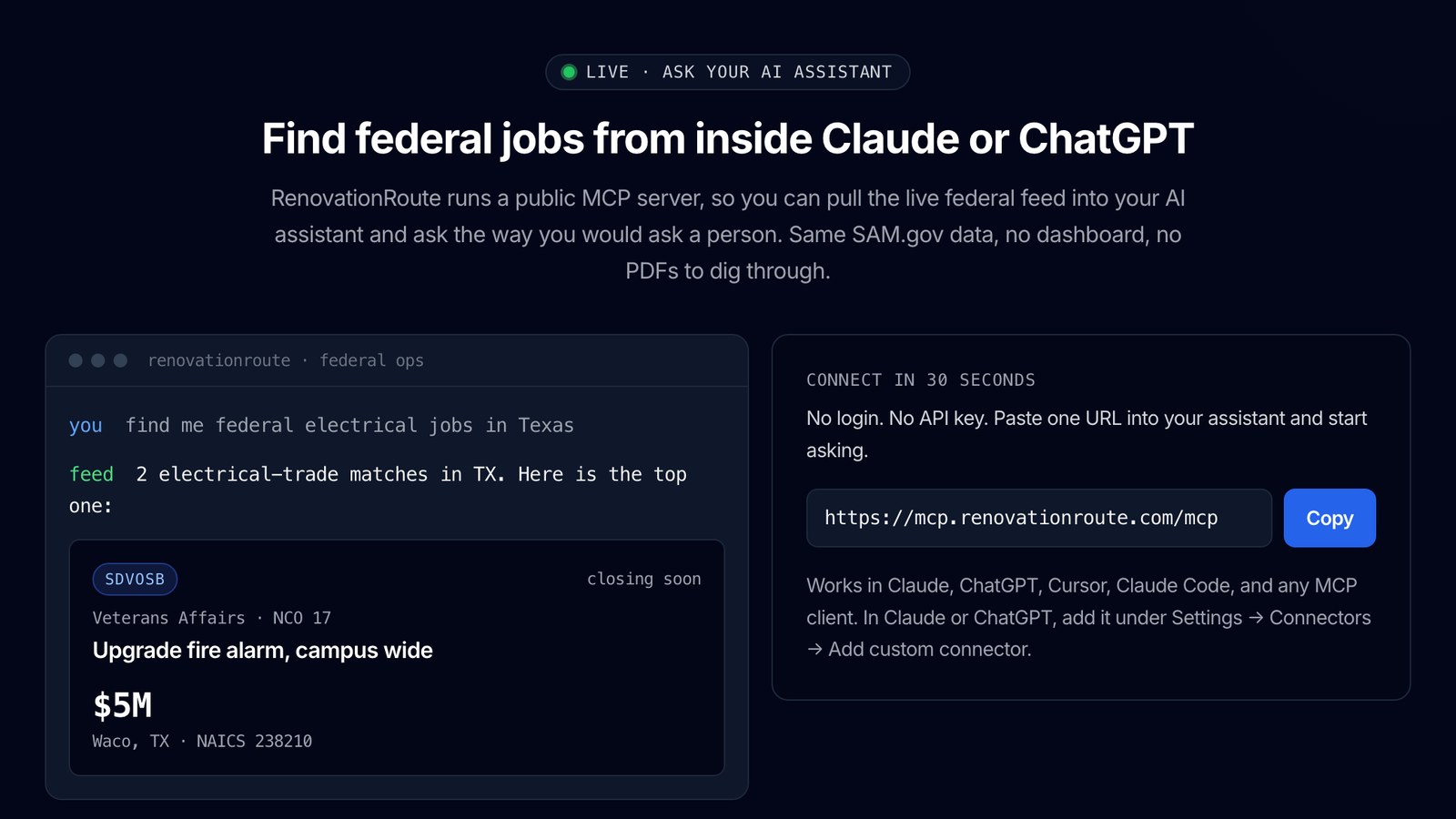
It also runs inside Claude and ChatGPT. RenovationRoute has a public MCP server. Paste https://mcp.renovationroute.com/mcp into your assistant (no login, no API key) and ask “find me electrical jobs in Texas.” Results can include state and local bids alongside federal ones, and some may already be awarded, so check each one’s source and status. It searches open opportunities by state, NAICS code, keyword, and contract size, pulls the details on a specific notice, and shows where the work is by state.
Price: the bid list is free to browse. $20 a month gets the full briefs, including the disqualifiers and cost estimate, change alerts on jobs you follow, and the SMS and email alerts after each SAM.gov sweep, every 12 hours.
Pick something else if you need AI to write long technical proposals, or you bid outside construction. It doesn’t do either.
2. GovDash: end-to-end AI for proposal teams
Best for: firms with a capture and proposal team writing technical proposals.
GovDash describes itself as end-to-end: capture, proposal development, pricing, and contract management. Its AI is trained on federal procurement data and the FAR. It parses Section L and M, builds compliance matrices, and hooks into Word, SharePoint, and Salesforce. It says it’s FedRAMP Ready and claims compliant proposals 50 to 60 percent faster.
Price: not published.
For construction, it’s strong if you write large best-value proposals. Overkill if your bids mostly come down to price.
3. Procurement Sciences (Awarded AI) and HigherGov
Best for: teams that want AI drafting plus a big market-data service.
Procurement Sciences’ Awarded AI does predictive win-probability scoring, compliance-first drafting, and color review automation. In May 2026 it acquired HigherGov. HigherGov still runs as its own product, and it publishes its prices: $500 a year for one user, $2,500 a year for up to 10, with AI tools in every plan.
Price: HigherGov is published. Awarded AI is by quote.
For construction, HigherGov at $500 is the best-value general search tool for any industry. We put it head to head in HigherGov vs GovWin vs GovTribe vs Federal Compass.
4. SamSearch (Sammy)
Best for: firms that want an AI assistant across federal, state, and local bids.
SamSearch’s assistant, Sammy, extracts requirements, summarizes long RFPs, answers questions about a specific document, and drafts structured proposal outlines. It covers federal, state, local, defense, GSA eBuy, and subcontracting.
Price: not published. SamSearch’s pricing page says the price depends on your team size and markets, and you get a number after a demo.
For construction, the document Q&A is handy, but it’s general-purpose. It won’t estimate cost by work item or show who wins that office’s construction work.
5. GovWin IQ with Dela AI
Best for: large primes that need analyst intelligence before solicitations post.
Deltek added Dela to GovWin IQ. It’s an AI assistant you ask questions in plain language, plus Smart Summaries and Smart Fit Scores. The core of GovWin is still its analyst-researched intel on programs and budgets, well before a solicitation posts.
Price: not published. Reported at roughly $13,000 to $119,000 a year, averaging near $29,000.
For construction, it’s only worth it if you’re a large prime chasing big programs a year out.
6. GovTribe AI
Best for: mid-market discovery with a conversational search layer.
GovTribe’s AI adds a conversational interface for opportunity search and competitor research. It’s sold as a subscription with AI credits.
Price: published, $1,500 to $6,000 a year. AI and MCP use costs credits on top.
7. Sweetspot
Best for: matching opportunities to your capabilities and past performance.
Sweetspot uses AI to match opportunities to what your company has done before. It scans multiple sources and qualifies them against your past performance.
Price: not published.
What about plain ChatGPT and Claude?
Claude and ChatGPT are excellent at reading and writing. Drop a solicitation PDF in, ask what it requires, and you’ll get a useful answer. Two catches:
- They don’t know what posted on SAM.gov today unless you connect them to live data.
- They only read what you give them. If you didn’t download the amendment, they didn’t read it.
The fix for the first one is an MCP server. It’s a standard way to plug live data into your assistant. RenovationRoute’s is public and free to connect: https://mcp.renovationroute.com/mcp. Then you ask your assistant for construction work the way you’d ask a person. Results are mostly federal, plus some state and local bids, so check the source on each one.
Side by side
| Tool | Built for | AI focus | Price published? | Price |
|---|---|---|---|---|
| RenovationRoute | Construction | Reads the package: brief, disqualifiers, cost, checklist | Yes | Bid list free, $20/month for briefs + alerts |
| GovDash | Proposal teams | Capture, proposal drafting, compliance matrices | No | By quote |
| Procurement Sciences / HigherGov | All industries | Drafting, win probability; market data | HigherGov yes | HigherGov $500 to $2,500/year |
| SamSearch | All industries | Document Q&A, RFP summaries, outlines | No | By quote |
| GovWin IQ (Dela) | Large primes | Natural-language search over analyst intel | No | ~$13,000 to $119,000/year (reported) |
| GovTribe AI | Mid-market | Conversational search, competitor research | Yes | $1,500 to $6,000/year, AI credits extra |
| Sweetspot | All industries | Capability and past-performance matching | No | By quote |
How to choose
- Writing long technical proposals? GovDash or Procurement Sciences.
- Want the best general search for the money? HigherGov at $500 a year.
- A large prime working programs a year out? GovWin IQ.
- A construction contractor who needs to know which jobs to bid and what’s buried in the package? RenovationRoute. Start with the free bid list.
See What AI Finds in This Week's Federal Construction Jobs
The bid list is free to browse. For $20 a month, get the full brief on each job: the scope, what can disqualify you, and a cost estimate when there's enough to base one on. Or ask for jobs from inside Claude or ChatGPT.
Checked September 23, 2026; GovWin IQ and GovTribe prices rechecked September 29, 2026. Competitor features and prices come from each company’s own site or the cited third-party comparison. Most vendors don’t publish prices. Where we give a range, it’s reported, not quoted. We’ll update this post as tools change.
About the Author
Jesse Edwards is the founder of RenovationRoute and MS Tech Alpine Ventures. He built RenovationRoute’s AI for the one job construction contractors don’t have time for: read a solicitation and its attachments and tell them, in plain English, whether it’s worth bidding.
Frequently asked questions
- What is the best AI tool for government contracting in 2026?
- Depends where your hours go. If you're a proposal team writing long technical proposals, GovDash and Procurement Sciences are built for you. If you're a construction contractor, most of the work is reading the solicitation package and deciding whether to bid. RenovationRoute is the AI tool built for that. The bid list is free to browse, and full briefs are $20 a month.
- Can I use ChatGPT or Claude to find government contracts?
- Yes, if you hook them up to live data. On their own they don't see today's SAM.gov postings. RenovationRoute runs a public MCP server at mcp.renovationroute.com/mcp. Add it to Claude or ChatGPT (no login, no API key) and ask for construction jobs by state, trade, or keyword. Results are mostly federal from SAM.gov, plus some state and local bids, so check the source on each one.
- How much do AI government contracting tools cost?
- Most won't tell you. GovDash, SamSearch, and Sweetspot are quote-based. Civio publishes its prices, starting at $24,000 a year. GovWin IQ, which includes the Dela AI assistant, is reported at about $6,000 to $13,000 a year for one entry-level user, and $13,000 to $119,000 a year across deals. HigherGov, now owned by Procurement Sciences, publishes $500 a year for one user. RenovationRoute publishes its price too, $20 a month, and the bid list is free to browse.
- Do construction contractors need AI proposal writing tools?
- Usually less than IT and services firms do. Many federal construction solicitations are sealed bids or price-driven quotes, and the award goes to the lowest price among bidders who meet every requirement. The mistakes that cost you are a missed mandatory site visit, a set-aside you don't qualify for, bonding, or an amendment. That's a reading problem, not a writing problem.
- What does RenovationRoute's AI do?
- It reads the solicitation and its attachments, mostly federal construction jobs from SAM.gov plus some state and local bids, and turns them into a plain-English brief. It flags what can disqualify you, estimates cost by work item when there's enough scope and award history to base it on, shows who wins that office's work, and scores your fit. Pro members can get a bid checklist of every form, deadline, and gate with its PDF page. Code finds the requirements in the package, AI sorts them in two passes, and any number that isn't in the documents gets flagged.